- Tretinoin for Beginners: A Guide to Getting Started
- Should You Choose Cream or Gel?
- Which Strength is Right for You?
- Tretinoin for Sensitive Skin: How to Use It Safely
- Tretinoin for Acne
- Tretinoin for Hyperpigmentation
- Tretinoin for Wrinkles and Fine Lines
- Tretinoin for General Skin Texture
- Tretinoin for Sun Damage


Tretinoin vs Retinol: Which Is Stronger, and Which Should You Use?

Tretinoin vs retinol depends on how each ingredient acts in skin and what the evidence can show. Tretinoin is retinoic acid. Skin converts retinol through other forms before it reaches retinoic acid. In the UK, tretinoin is prescription-only and retinol is a cosmetic ingredient.
Human studies cover both ingredients, but their different designs do not provide a shared strength scale or timetable. Your skin concern and a prescriber’s assessment will guide whether tretinoin is suitable.
Tretinoin vs retinol at a glance
Tretinoin is retinoic acid. Skin converts retinol before it reaches that form. Percentages in different products do not provide a direct strength comparison.
| Point | Tretinoin | Retinol |
|---|---|---|
| What it is | All-trans retinoic acid, a topical retinoid medicine | A vitamin A precursor used in cosmetic products |
| Form in the skin | Already retinoic acid | Converts through retinaldehyde to retinoic acid |
| UK status | Prescription-only medicine | Cosmetic ingredient |
| Strengths | Prescribed formulations vary; no direct retinol conversion | Products and formulations vary; percentages are not directly comparable |
| Human evidence | Clinical trials include acne and photoageing research | Human studies include skin structure and wrinkle outcomes |
| Irritation | Can cause dryness, redness and scaling; response varies | Often described as gentler, though irritation still occurs |
| Time to visible change | Depends on the condition, formulation and treatment plan | Depends on the product and concern; no fixed comparison with tretinoin |
| Pregnancy | Should not be used during pregnancy or while trying to conceive | Ask a GP, midwife or pharmacist before use in pregnancy |
People use “stronger” to mean faster action, more irritation or a larger change in a study. Trials use different formulations, skin sites and outcome measures, so percentages alone cannot settle the comparison.
Is tretinoin a retinol?
Tretinoin and retinol are both retinoids, but they take different routes through the skin. Tretinoin is retinoic acid. Retinol reaches that form through conversion, while its formulation affects delivery. Their percentages therefore do not translate into a shared strength scale. This answers the common search, “is tretinoin a retinol?”
Retinol reaches retinoic acid through these conversion steps:
- Retinyl esters convert to retinol.
- Retinol converts to retinaldehyde.
- Retinaldehyde converts to retinoic acid.
A human skin study describes the conversion of retinol to retinaldehyde and then retinoic acid. Duell et al. also found that penetration differed by retinoid and vehicle, with results affected by occlusion. Duell et al.
Retin-A vs retinol: what human studies found about tretinoin vs retinol
Human studies report changes with both ingredients. Differences in participants, skin sites, formulations and outcomes make direct product comparisons difficult.
- In Kong et al.’s comparison, four weeks of retinol and retinoic acid increased epidermal thickness and collagen-related gene and protein expression. Kong et al. Facial image analysis found fewer wrinkles after 12 weeks of retinol. Kong et al. The authors described the changes as similar in type and generally smaller in magnitude with retinol.
- In an earlier human skin study, retinol produced epidermal thickening similar to retinoic acid under the test conditions, with little measured redness. It did not significantly raise measured retinoic acid levels. Researchers used normal buttock skin under occlusion for four days. Kang et al.
- A vehicle-controlled trial in naturally aged skin found that 0.4% retinol lotion improved fine-wrinkle scores compared with vehicle after 24 weeks. Kafi et al. Study staff applied it to participants’ arms up to three times weekly. Kafi et al.
- Research into penetration found different results for retinol, retinaldehyde and retinyl palmitate, depending on occlusion and vehicle. The authors called retinol weaker than retinoic acid. They also noted that penetration in their unoccluded experimental vehicle affected delivery. Duell et al.
- A trial compared 0.1% and 0.025% tretinoin for photoaged facial skin. Griffiths et al. Both improved photoageing compared with vehicle. The higher concentration caused more irritation, with no significant difference in efficacy between the two strengths. Griffiths et al.
Is 0.025% tretinoin stronger than 1% retinol?
There is no validated conversion between 0.025% tretinoin and 1% retinol. For tretinoin vs retinol, concentration alone cannot show which will work better for an individual. Products differ in stability and delivery, and studies use different methods. Tretinoin requires a prescriber’s assessment and directions.
Penetration studies may use an experimental vehicle or occlusion. A cosmetic serum, cream and prescription medicine can behave differently. Human comparisons of retinol and retinoic acid do not establish a ratio between retail products. The search “is 0.025 tretinoin stronger than 1 retinol” has no evidence-based percentage answer.
A percentage chart cannot replace a prescription. Speak with your prescriber before starting, stopping or changing tretinoin. In the UK, tretinoin is prescription-only.
Retinol vs tretinoin: what UK search data shows
Our analysis of UK Google search data found 25,500 searches for “retinol vs tretinoin” in the 12 months to August 2026, up from 23,100 in the previous 12 months. The first 12 months in the four-year series had 29,900 searches, so the latest total remained 15% lower than that starting period. Google groups close variants into rounded buckets. These are search estimates, not counts of people or purchases.
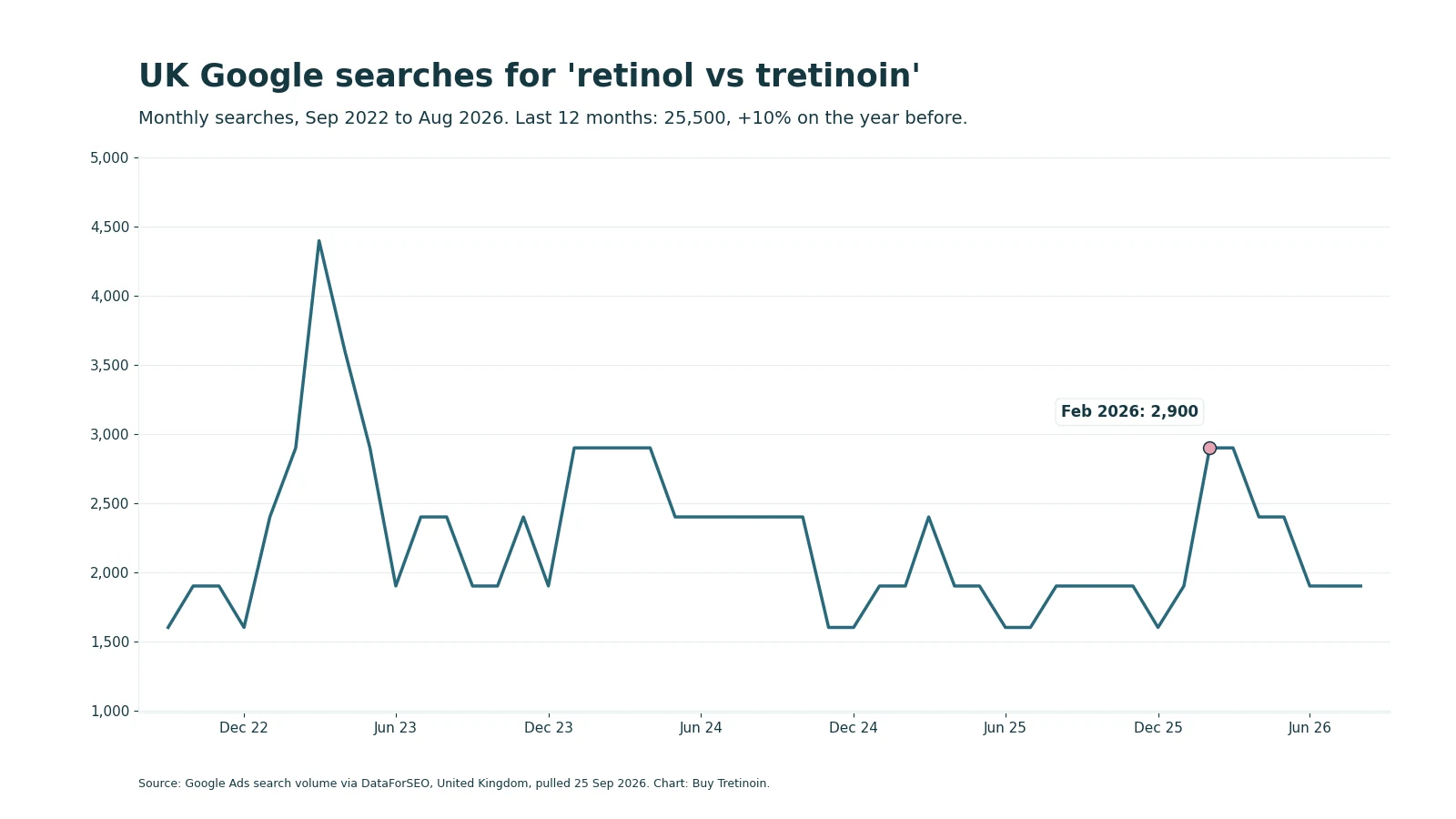
Search volume rose from the previous year but remained below its level in September 2022 to August 2023. Search totals cannot show which ingredient suits an individual reader’s skin.
From our order data (Sep 2025 to Sep 2026): The underlying WooCommerce period is 14 September 2025 to 14 September 2026. We recorded 1,588 tretinoin units and 9 retinol face creams, or about 176 tretinoin units per retinol cream. This covers one store and UK customers; units are not people. December 2025 had no orders, which may reflect a store closure or a data gap.
These figures show purchases through one UK store during the stated period. They do not explain individual choices or describe skincare use across the UK.
Retinol or tretinoin: who may suit each option
A cosmetic retinol may suit someone looking for a non-prescription retinoid who can follow the product instructions. If your skin is sensitive or rosacea-prone, ask a GP, pharmacist or dermatologist before adding it.
Tretinoin needs a prescriber’s decision and is used for concerns such as acne or photoageing when the prescriber considers it suitable. Tell the prescriber about your current routine, including retinol use.

If a retinoid causes persistent burning or marked irritation, stop using it and ask a GP, pharmacist or dermatologist for advice. Seek prompt advice for swelling, blistering, severe pain or eye symptoms. Speak with a clinician before using a retinoid on broken skin or if a skin condition may affect treatment.
Can you use retinol and tretinoin together?
Using cosmetic retinol alongside prescribed tretinoin adds another retinoid and may increase irritation. Follow both products only if the prescriber managing your tretinoin has advised you to do so.
Some people use retinol body lotion on areas where they do not apply facial tretinoin. The product label still applies. Our guide to retinol body lotion covers that routine.
Switching from retinol to tretinoin
Speak with a prescriber before switching to tretinoin. Your reason for treatment, skin history and current products can affect the plan. Do not layer it over retinol or change prescribed directions yourself.
- Tell the prescriber which retinol product you use, how often, and whether it irritates your skin.
- Follow the strength and schedule your prescriber gives you. Do not apply extra to speed results.
- Ask your prescriber or pharmacist whether you should adjust other skincare products or use sun protection.
- Ask your prescriber when to check in and which changes need a call. Contact them promptly for severe or unusual symptoms.
Read our beginner’s guide to tretinoin, guide to tretinoin strengths, adapalene vs tretinoin comparison, tazarotene vs tretinoin comparison, tretinoin before and after guide and tretinoin purge guide. Tretinoin should not be used in pregnancy or when trying to conceive. The same advice applies to adapalene and tazarotene. Ask your GP, pharmacist or dermatologist for advice.
Retin-A and retinol: what is the difference?
Retin-A is a brand name used for tretinoin products. Retinol is a separate retinoid ingredient. The Retin-A and retinol difference is the active ingredient; names and formulations can vary by country. If you searched for tretinoin vs Retin-A, check the ingredient and follow your prescriber’s or pharmacist’s directions.
Choosing your next step
If you are considering prescription treatment, speak with a GP or dermatologist about your skin concern. You can read about our tretinoin range, our retinol range and buying tretinoin cream in the UK. Product pages do not replace a prescriber’s assessment or directions.
Frequently asked questions
Is 0.025% tretinoin stronger than 1% retinol?
There is no validated conversion that makes 0.025% tretinoin equal to, or a fixed multiple of, 1% retinol. Studies use different formulations, methods and outcomes, so their percentages cannot be compared as a dose chart. A prescriber can advise whether tretinoin is suitable for you and explain how to use it safely.
What is better for ageing skin, retinol or tretinoin?
The better option depends on your skin concern and whether a prescriber considers tretinoin suitable. Human studies report changes with both ingredients, but they do not make every retinol product comparable with every tretinoin formulation. Retinol is a cosmetic option in the UK. Tretinoin is prescription-only.
Is Retin-A the same as tretinoin?
Retin-A is a brand name used for tretinoin products. Tretinoin is the active medicine name, also called all-trans retinoic acid. Product names and formulations can vary by country, so check the ingredient and follow the directions from your prescriber or pharmacist.
Can I use retinol while pregnant?
Ask your GP, midwife or pharmacist before using a retinoid skincare product during pregnancy. Tretinoin should not be used in pregnancy or when trying to conceive. The same advice applies to adapalene and tazarotene. If you are using a prescribed treatment and become pregnant, contact your prescriber for advice before continuing.
Why is tretinoin prescription-only in the UK?
Tretinoin is a prescription-only medicine in the UK, so a prescriber must assess whether it is appropriate and explain its use. Suitability can depend on your skin and medical circumstances. Do not use tretinoin without a prescription or change a prescribed plan without speaking to your prescriber.
How long does retinol take to work compared with tretinoin?
No reliable timetable compares all retinol and tretinoin products. Studies differ in concentration, formulation, body site and outcome measures. One retinol trial assessed naturally aged skin over 24 weeks (Kafi et al.); another compared skin changes after four weeks (Kong et al.). Your own results and tolerance can differ.
How we wrote this
We reviewed PubMed abstracts on retinol, retinoic acid and tretinoin, including comparative and vehicle-controlled human studies. We also analysed UK Google search data from September 2022 to August 2026 and WooCommerce orders from 14 September 2025 to 14 September 2026. Google rounds search volumes and groups close variants. Orders come from one store and do not describe skincare use across the UK.
For personal medical advice, speak with a GP, pharmacist or dermatologist. Tretinoin should not be used in pregnancy or when trying to conceive. The same advice applies to adapalene and tazarotene. Last reviewed 25 September 2026. Corrections: support@buytretinoin.org.