Tazarotene vs Tretinoin for Wrinkles: What the Evidence Shows
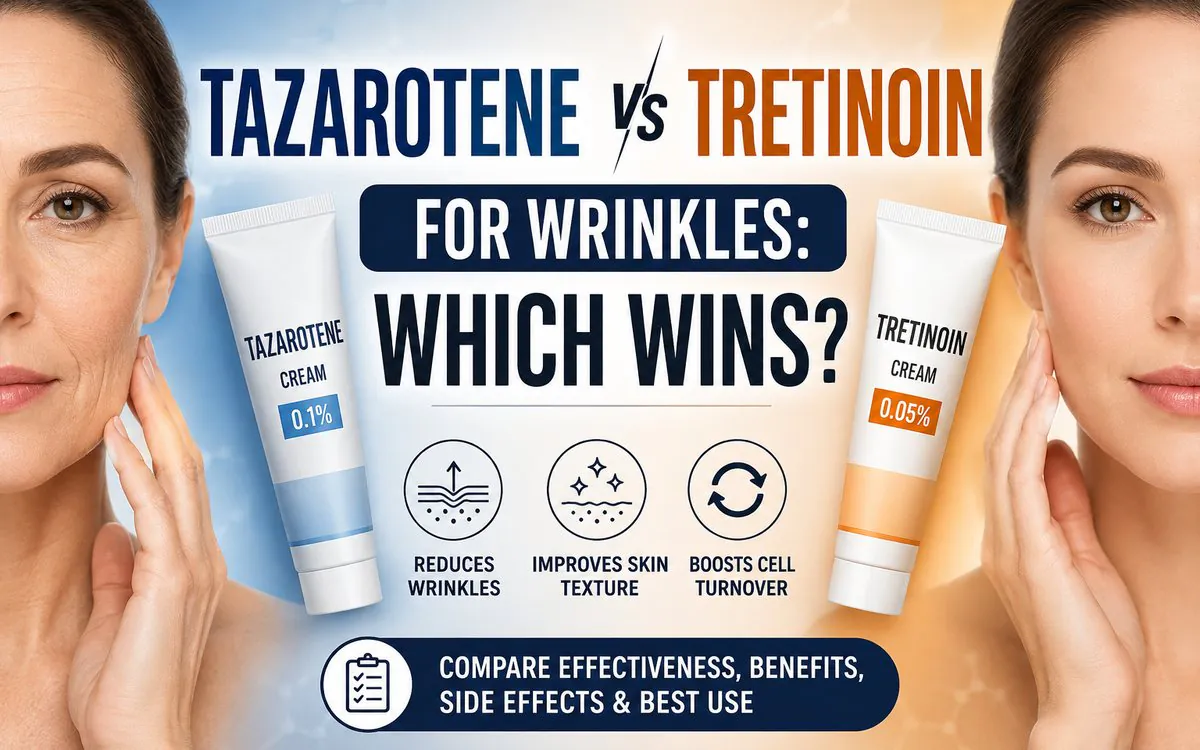
Tazarotene vs tretinoin: direct wrinkle trials found improvements with both medicines, and one favoured tazarotene on specific measures. The trials tested particular creams over a set period, so their results do not predict an individual's response to another product.
Both are topical retinoids. The diagnosis and the product available in the UK shape any treatment discussion. The eMC lists Treclin, a tretinoin and clindamycin gel, as prescription-only; our eMC and MHRA searches did not identify a tazarotene product record, which does not prove that no authorisation exists.
What the wrinkle evidence says about tazarotene vs tretinoin
Two direct photoageing trials compared tazarotene and tretinoin creams in people with facial photodamage. Their designs and outcome measures differed, which limits the comparison.
| Study | Design and participants | Products and duration | Reported result | What it cannot establish |
|---|---|---|---|---|
| Kang et al. (2001), PMID 11735710 | Multicentre, investigator-masked, randomised, parallel-group trial; 349 people with facial photodamage | Tazarotene cream at 0.01%, 0.025%, 0.05% or 0.1%, vehicle, or tretinoin 0.05% emollient cream; once daily for 24 weeks | Both medicines improved fine wrinkles and mottled hyperpigmentation. At week 24, global treatment success was reported in 67% of the 0.1% tazarotene group and 55% of the tretinoin group. | The global response is not a promise for an individual or proof that every tazarotene product is better. The formulations and study population were specific. |
| Lowe et al. (2004), PMID 15203997 | Multicentre, double-blind, randomised, parallel-group trial; 173 enrolled and 157 completed, with facial fine wrinkling and mottled hyperpigmentation | Tazarotene 0.1% cream compared with tretinoin 0.05% emollient cream; once each evening for 24 weeks | The abstract reports significant between-group differences in efficacy measures favouring tazarotene, including fine wrinkling at the endpoint. Burning was transiently more frequent in the tazarotene group during the first week. | The abstract gives no arm-level response percentages or confidence intervals, so the size and wider relevance of the differences remain unclear. |
The first trial's response percentages describe a global assessment. Its arm counts were small, and local adverse events were generally mild to moderate and more frequent at higher tazarotene concentrations.
The Lowe trial directly compared defined measures, although its abstract does not give the size of the differences. Both trials lasted 24 weeks and used creams with different vehicles. Results for another strength, gel or schedule remain unknown.
What separate vehicle-controlled trials add
Separate vehicle-controlled trials provide evidence for each medicine in photoageing. Their different methods do not support a direct ranking. Tazarotene 0.1% cream reduced fine wrinkles compared with vehicle in a multicentre, randomised, double-blind trial of 568 people with facial photodamage over 24 weeks (PMID 15692472). The abstract describes irritation events as predominantly mild or moderate, without a numerical effect size.
A tretinoin trial compared three concentrations in emollient cream with vehicle in a 24-week, double-blind, randomised, multicentre study of 296 people with photodamaged facial skin. Tretinoin 0.05% had a better global response than vehicle, with improvement reported in 68% versus 43% (PMID 1552056). Comparing that percentage with a separate tazarotene trial would mix study populations, vehicles and outcome assessments.
An earlier randomised, double-blind, vehicle-controlled study included 30 completers and examined tretinoin for photoaged skin over 16 weeks. The abstract reports facial improvement in 14 of 15 people who received tretinoin and none of the vehicle-treated faces (PMID 3336176). Its small sample and distinct design limit how far that result can be generalised.
These trials used named creams and specific wrinkle assessments. Their results apply to those study products and measures.
The Cochrane review included 30 studies of variable quality and said there was limited evidence from one trial about equivalence between tretinoin 0.05% and tazarotene 0.05% or 0.1% (PMID 15674885). That review does not support a simple claim that one ingredient is always more effective.
Why acne comparisons do not settle wrinkles
Acne trials answer questions about acne lesions, not photoaged skin or wrinkle scores. A comparative acne paper reported preliminary differences in papules, open comedones and pustules for particular gels (PMID 10898831). Those outcomes cannot establish which cream is more effective for wrinkles, so acne evidence should not be used to declare a winner here.
Is tazarotene stronger than tretinoin?
In a tazarotene vs tretinoin comparison, the percentage printed on a product cannot rank the medicines. The active ingredients and cream vehicles differ, so a percentage only describes the product and study in which it was tested.
In the Kang study, researchers compared several tazarotene cream strengths with tretinoin 0.05% emollient cream. In the Lowe study, they compared tazarotene 0.1% cream with tretinoin 0.05% emollient cream. The studies do not show that a larger percentage of one medicine can be directly matched to a smaller percentage of the other.
“Stronger” is only useful when the outcome is clear. The direct photoageing studies assessed fine wrinkling and global improvement; acne comparisons counted lesions. These measures answer different questions, and they cannot predict an individual's response or tolerability.
- A strength percentage applies to a particular active ingredient and formulation.
- A trial outcome applies to the participants, schedule and measure used in that study.
If a prescriber discusses either medicine, ask which outcome they expect it to address, what evidence applies to the exact product, and when they will review the decision.
Our guide to how concentration labels should be read explains why percentages need product context.
Irritation and tolerability
Both medicines can irritate skin. In the Lowe comparison, burning was transiently more frequent with tazarotene during the first week, with no difference thereafter.
In a separate 24-week tazarotene vehicle-controlled trial, adverse events were predominantly mild or moderate signs or symptoms of skin irritation (PMID 15692472). The US Tazorac cream label reports peeling, dry skin, redness and burning among common adverse reactions in its own clinical data. That is US product information and should not be treated as a UK frequency estimate or as a head-to-head comparison.
Irritation rates from one medicine label cannot be used to compare every tazarotene and tretinoin product. The formulation, study population and reporting method matter when interpreting those figures.
The eMC lists dry skin, redness, itching, rash, peeling and sunburn among uncommon skin reactions for Treclin, a tretinoin and clindamycin combination. It also lists uncommon application-site burning and dryness in the Treclin Summary of Product Characteristics. These frequencies apply to Treclin.
When discussing irritation with a prescriber or pharmacist, mention:
- the exact product and directions you were given;
- when symptoms began and whether they are getting worse;
- any other skin medicines or products you are using.
If irritation begins, follow the directions for the exact product and ask what to do. Do not change a prescription schedule or switch medicines on your own.
Our guides cover tretinoin irritation and side effects and retinoids and sensitive skin.
Tazarotene and tretinoin in the UK
Tretinoin is prescription-only in the UK where supplied as a medicine, while our searches did not identify a tazarotene product record in the eMC or MHRA resources checked. That search result does not prove that no authorised tazarotene product exists.
Is tazarotene available in the UK?
On 19 October 2026, the eMC search for tazarotene did not identify a product record, and the MHRA product search did not establish an exact tazarotene authorisation. The searches provide a snapshot of those resources on that date. They do not confirm whether a tazarotene product is authorised in the UK.
If a product is offered from another country, its listing does not establish its UK status, formulation or suitability for you. Ask a UK prescriber or pharmacist to check the exact product. The tazarotene products this store lists are on our tazarotene category page.
Is tretinoin prescription-only in the UK?
The eMC lists Treclin as a prescription-only combination of clindamycin and tretinoin, indicated for acne vulgaris, not wrinkles. Its product information cannot establish the legal status, indication or directions of every tretinoin-only or imported product.
The NHS describes topical tretinoin as an acne treatment. Regulation 284 of the Human Medicines Regulations prohibits an advertisement likely to lead to use of a prescription-only medicine (legislation.gov.uk).
Pregnancy and when to seek advice
Tretinoin, adapalene and tazarotene should not be used during pregnancy or when trying to conceive. NICE says topical retinoids are contraindicated during pregnancy and when planning pregnancy in its acne guidance, recommendation 1.5.8 (NICE NG198). The US Tazorac label also contraindicates its tazarotene cream in pregnancy (DailyMed label).
The US label covers the named US product. Other formulations may have different product information. If you are pregnant, planning pregnancy or think you may be pregnant, contact the prescriber promptly for advice about your exact medicine. Do not use research about pregnancy exposure as permission to start or continue treatment.
Stop using the prescribed product and speak to a GP, pharmacist or dermatologist if irritation is severe or persistent, or if you develop swelling, blistering or a marked rash. Get advice about the exact product before restarting or changing treatment.
Seek advice from a GP, pharmacist or dermatologist if:
- irritation is severe, persists or worsens despite following the product directions;
- you develop swelling, blistering, a marked rash or another reaction that concerns you;
- you are pregnant, trying to conceive, or think you may be pregnant;
- you are unsure whether a medicine or product is the one prescribed to you.
Do not share prescription medicines or make a switch between retinoids without the prescriber's guidance. The sources reviewed here do not establish a general breastfeeding rule for tazarotene, so ask a prescriber about the exact medicine rather than applying one product's wording to another.
Who might discuss each option with a prescriber?
Someone asking about tazarotene for wrinkles or tretinoin for wrinkles can use the trial evidence to frame a discussion, but the studies cannot determine personal suitability. A prescriber can consider the reason for treatment, the exact available product, skin history, pregnancy plans and whether the expected outcome is worth the possible irritation.
Useful questions to bring to that discussion include:
- Which specific skin concern is the medicine intended to address?
- Does the cited evidence apply to this exact product and formulation?
- What irritation should prompt a call, and when should treatment be reviewed?
- Is a different option more appropriate for my skin or medical history?
Switching should be planned with the prescriber. Do not combine tazarotene and tretinoin or alter how often you apply a prescription unless the prescriber has advised you to do so. For routine context, see our guide to building a tretinoin routine and the comparison of retinol and tretinoin.
Frequently asked questions
Is tazarotene or tretinoin better for wrinkles?
The available head-to-head trials do not establish one option as better for every person. A 24-week trial reported advantages for tazarotene on some measured outcomes, while another found improvements with both medicines. The studies tested particular creams and wrinkle assessments. A prescriber can discuss whether either medicine is appropriate for your skin and treatment goal.
Is tazarotene stronger than tretinoin?
A strength percentage cannot rank tazarotene against tretinoin because the medicines and tested formulations differ. One facial photodamage trial compared tazarotene cream at several concentrations with tretinoin 0.05% emollient cream, while another compared tazarotene 0.1% cream with tretinoin 0.05% emollient cream. The results apply to those trial products and outcomes, not to every product.
Does tretinoin improve wrinkles?
Vehicle-controlled trials have reported improvements in photoaged skin with tretinoin, including fine wrinkling. One 24-week randomised trial studied 296 people with photodamaged facial skin and found a better global response with tretinoin 0.05% emollient cream than with its vehicle. That group result does not promise a visible change for an individual or establish that tretinoin suits everyone.
Is tazarotene available in the UK?
Searches of the eMC and MHRA product resources checked on 19 October 2026 did not identify a tazarotene product record. Search absence cannot prove that no UK-authorised product exists, and it does not establish the status of a product sold elsewhere. Ask a UK prescriber or pharmacist about the exact medicine and its status.
Is tretinoin prescription-only in the UK?
The eMC lists Treclin, a prescription-only combination of tretinoin and clindamycin for acne; it is not a tretinoin-only wrinkle product. A prescriber must assess the exact product and reason for use.
Can tazarotene or tretinoin be used in pregnancy?
Tretinoin, adapalene and tazarotene should not be used during pregnancy or when trying to conceive. NICE says topical retinoids are contraindicated during pregnancy and when planning pregnancy in its acne guidance. The US Tazorac label also contraindicates tazarotene in pregnancy. Tell your prescriber if you are pregnant, planning pregnancy or think you may be pregnant.
What did the direct wrinkle trial compare?
The 24-week Lowe trial enrolled 173 people with facial photodamage and compared tazarotene 0.1% cream with tretinoin 0.05% emollient cream. Both were applied in the evening. The abstract reports that significant differences in measured efficacy outcomes favoured tazarotene, with transiently more burning in the first week. The finding concerns those creams and trial outcomes, not every formulation or patient.
How we wrote this
This article draws on published abstracts for direct and vehicle-controlled photoageing trials, a Cochrane review, acne comparison studies, NICE guidance, eMC product information, MHRA resources and a US medicine label. The evidence cannot predict an individual's response or establish a universal ranking. This is general information, not medical advice; for advice about a specific medicine, speak to a prescriber. Last updated: November 2026. Corrections: support@buytretinoin.org