- Tretinoin for Beginners: A Guide to Getting Started
- Should You Choose Cream or Gel?
- Which Strength is Right for You?
- Tretinoin for Sensitive Skin: How to Use It Safely
- Tretinoin for Acne
- Tretinoin for Hyperpigmentation
- Tretinoin for Wrinkles and Fine Lines
- Tretinoin for General Skin Texture
- Tretinoin for Sun Damage


Tretinoin Under Eyes: Is It Safe, and Does It Work?


Tretinoin under eyes may soften fine lines, though it can irritate the delicate skin around the eyes. Evidence for wrinkles comes mainly from facial studies that measured crow’s feet. A 2026 review found more eye discomfort with topical vitamin A products used near the eye.
Tretinoin is prescription-only in the UK. Use it around the eyes only if your prescriber has advised you to, and follow their directions. Keep it away from the lash line. Stop and seek advice if skin or eye symptoms develop.
Can you use tretinoin under eyes?
Use tretinoin under eyes only if a prescriber has recommended it for you. Small facial studies found improved wrinkles around the eyes. A newer review found higher odds of pain, dryness and burning with topical vitamin A products used nearby. The evidence certainty was low to very low.
The studies do not establish a safe routine for everyone. Check with your prescriber before using a face prescription on your eyelids or under-eye skin. Tretinoin is prescription-only in the UK.
What tretinoin changes around the eyes
Tretinoin’s best-supported target is fine surface wrinkling from photodamage. It is not expected to change hollows or puffiness, and dark circles have several possible causes.
| Concern | Likely effect | Why | Better next step |
|---|---|---|---|
| Fine lines and crow’s feet | May soften | Facial trials assessed smoother skin and fewer fine wrinkles | Discuss eye-area use with your prescriber |
| Crepey texture | Possible modest improvement | Texture can reflect surface photodamage and dryness | Use moisturiser and daily sun protection |
| Pigmented dark circles | Uncertain | Tretinoin may affect surface pigmentation, but causes vary | Ask a clinician about the cause |
| Vascular-looking dark circles | Unlikely to change | A topical retinoid does not remove visible vessels | Seek advice if new or persistent |
| Hollows or shadows | No expected change | These relate to facial shape and light | Consider clinical advice if concerned |
| Puffiness | No expected change | Tretinoin does not address fluid or tissue swelling | Seek advice for persistent or sudden swelling |
| Milia | Not an established treatment | The studies below did not test milia | Ask a pharmacist or GP about options |
Tretinoin eye wrinkles: what studies show
Facial studies offer indirect evidence about tretinoin eye wrinkles. They suggest a possible effect on surface lines, but do not show how well tretinoin works when applied specifically beneath the eyes.
- In a six-month controlled study, 0.05% tretinoin cream improved several signs of facial photodamage Leyden et al., 1989. Silicone casts from the crow’s-feet area showed a smoother, less wrinkled surface in the tretinoin group.
- Two controlled studies of 0.02% cream reported significant improvement in fine and coarse facial wrinkling at the 24-week endpoint Nyirady et al., 2001. The abstract reports no separate under-eye result.
- A small, open-label facial study followed 19 people for 52 weeks Kircik et al., 2012. Twelve completed it, and the authors reported improvement in fine wrinkling. Its size and lack of a control group limit the conclusion.
- A one-month study of 0.25% tretinoin solution reported improved facial fine lines Kligman et al., 2004. It examined photoaged facial skin and does not recommend this strength near the eyes.
One trial measured crow’s-feet changes, while the other studies assessed facial fine wrinkling. The studies do not show what result to expect under the eyes or which strength would suit this area. Ask your prescriber before applying tretinoin to your eyelids.
Retin A eyes: the 2026 safety evidence
A 2026 systematic review and meta-analysis examined topical vitamin A products applied to the ocular surface or periorbital area. It included 89 studies with 10,794 participants, and 55 studies contributed to the meta-analysis. Abbott et al., 2026.
The pooled odds ratios were 6.37 for pain, 2.69 for dryness, 2.44 for burning and 1.71 for any harm. Abbott et al., 2026. Serious adverse events were uncommon and not significantly increased, with an odds ratio of 1.21. Abbott et al., 2026. These are pooled odds, not a person’s absolute chance of harm. The authors rated the evidence certainty very low to low.
The review found higher odds of harm with prescription-strength products. It combined topical vitamin A products and different study types. Because the review combined different products and study types, it cannot give an individual’s risk or a safe distance from the eye. A separate review examined dry-eye effects from oral isotretinoin, which provides no direct evidence about topical tretinoin. Ruiz-Lozano et al., 2020.
UK search demand
UK searches for the exact phrase “tretinoin under eyes” totalled 2,330 from September 2025 to August 2026. The previous 12 months totalled 2,570, a 9% decrease. The first 12 months in the four-year comparison had 2,420 searches. The latest total was 4% lower than that first period. Search counts show interest in a topic, not what people plan to do.
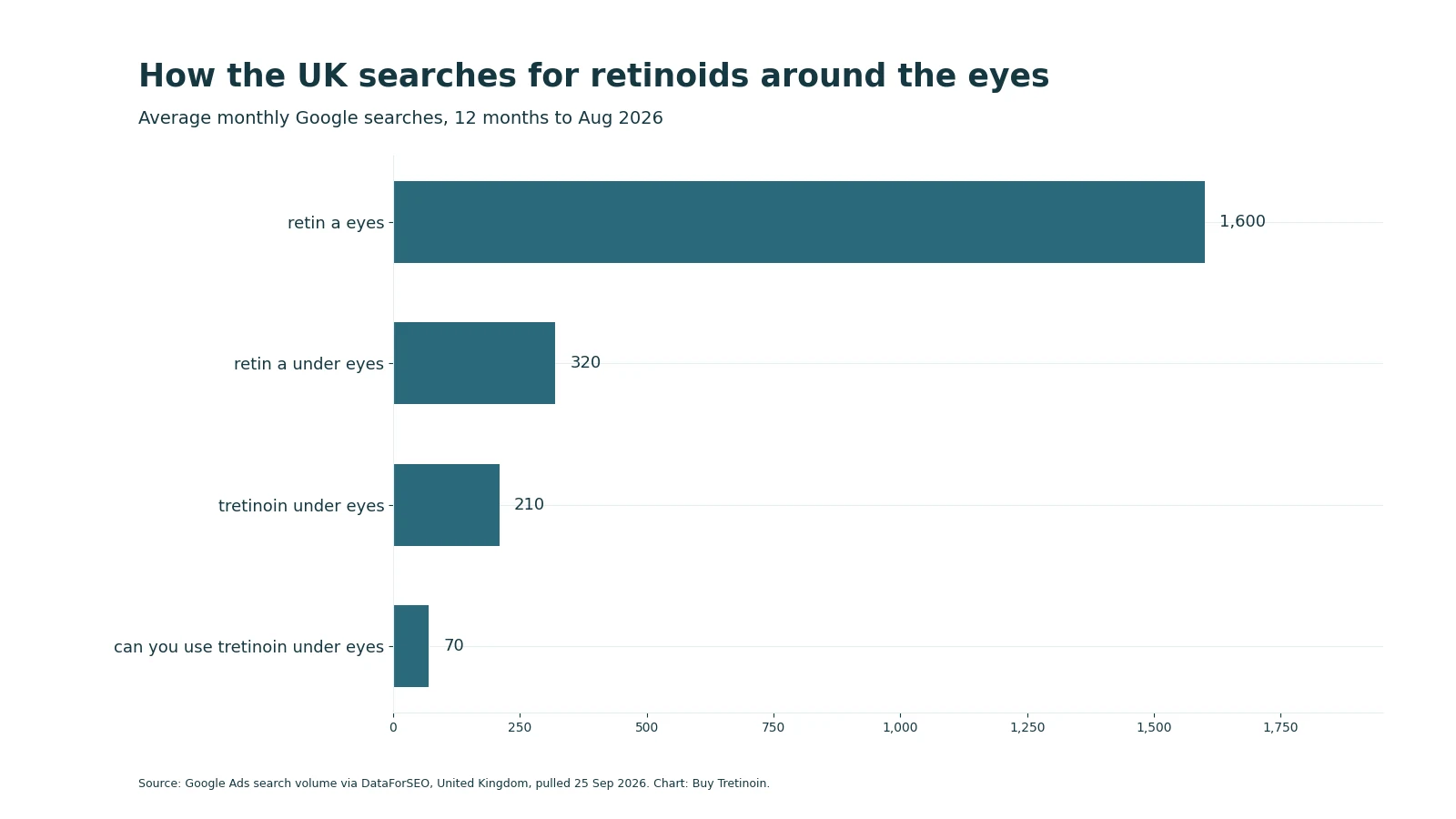
Our analysis of UK Google search data found average monthly volumes of 1,600 for “retin a eyes”, 320 for “retin a under eyes” and 210 for the primary query. Google groups close variants into rounded buckets, so these figures show relative demand. They cannot identify distinct people. These searches make clear why safety guidance belongs alongside information about use.
From our order data (Sep 2025 to Sep 2026): the extraction period was 14 Sep 2025 to 14 Sep 2026. We recorded 1,588 tretinoin units sold to UK customers through one store. Unit counts are not people. December 2025 has no orders, which may reflect a store closure or a data gap.
These are sales units from one UK store. They do not show how many people used tretinoin or where they applied it.
The 2026 review found increased odds of discomfort, with evidence certainty rated very low to low. A prescriber can discuss how that evidence applies to you.
How to use tretinoin for under eyes safely
Use tretinoin near your eyes only if your prescriber has specifically told you to. Ask them first if the directions are unclear. Follow the amount and frequency on your prescription instead of using a general online routine.
- Make sure you tolerate your prescribed face routine before asking whether it can include the eye area.
- Follow the amount and frequency on your prescription. The usual pea-sized amount applies to the whole face, not as a separate dose under each eye.
- Keep the medicine away from your eyelids, lash line and the eye itself unless your prescriber has instructed otherwise.
- Apply only to clean, fully dry skin if that matches your instructions. Avoid broken, inflamed or freshly treated skin.
- Wash your hands after applying it. Check with the treating clinician before using tretinoin ahead of an eye procedure.
- Stop using it around the eyes and contact a GP, pharmacist or dermatologist if irritation persists. Seek prompt eye care for pain or changes in vision.

Pregnancy: do not use tretinoin if you are pregnant or trying to conceive. Speak to your prescriber about your treatment.
Tretinoin under eyes before and after: what to expect
Before-and-after photos can be difficult to compare because lighting, expression and camera distance affect how fine lines look. The studies above assessed facial changes over 24 weeks or six months, and some included the crow’s-feet area. They do not predict an individual result beneath the eye.
If your prescriber recommends this use, agree when to review it and what change would count as worthwhile. Take photos in consistent lighting and from the same position if your clinician asks you to track progress. Stop sooner if irritation develops. Our guide to tretinoin before and after explains why timelines and photos need context.
Who should avoid the eye area or seek advice
Ask a GP, pharmacist or dermatologist before using tretinoin near the eyes if you have dry-eye symptoms, eczema or rosacea there. Ask first after recent eye surgery or if contact lenses cause irritation. Get advice if the skin is broken or inflamed, or if you use a steroid cream nearby.
Stop and seek advice if you develop:
- Persistent burning, redness, swelling, cracking or peeling around the eye.
- A gritty feeling, unusual dryness or ongoing watering.
- Eye pain, light sensitivity, blurred vision or another change in sight. Contact an optician or GP promptly for eye symptoms.
- A rash that spreads or does not settle after stopping the medicine.
Children should use tretinoin only under a prescriber’s direction. Bring the product packaging and your current medicines list when you ask for advice.
Gentler options for the eye area
A fragrance-free moisturiser and daily sun protection can help dry or sun-exposed skin. Sunglasses may reduce squinting in bright light. Retinol eye products and peptide creams are cosmetic options, though ingredients and tolerability vary. Stop using any product that irritates your skin.
Compare ingredient types in our guide to tretinoin versus retinol. If you are considering an eye cream, see our under-eye cream range. Ask a prescriber or pharmacist if you are unsure whether a product is suitable alongside your prescription.
Where to find more guidance
Our guides cover wrinkles and sensitive skin. Read about tretinoin for wrinkles and fine lines and using tretinoin on sensitive skin. We also explain the tretinoin purge and tretinoin for stretch marks, which involves a different body area.
Frequently asked questions
How long does tretinoin take to work under eyes?
Tretinoin under eyes may take months to show a change. Facial studies assessed fine wrinkles at 24 weeks and six months, but those findings do not show what every under-eye area will do. Follow your prescriber’s review plan and stop sooner if your skin or eyes become irritated. Ask your prescriber when to review your own treatment.
Does tretinoin darken under eyes?
Irritation can leave the skin red or dry, and inflammation may lead to darker pigmentation. Tretinoin does not address every cause of dark circles, which can include shadows and visible blood vessels. Ask a GP, pharmacist or dermatologist about new, changing or persistent colour, especially if irritation is present.
Where should you not apply tretinoin?
Keep tretinoin away from your eyelids, lash line, the eye itself, corners of the nose and lips, and any broken or irritated skin unless your prescriber has given different directions. Check the prescription instructions before applying it near the eyes. If the directions do not mention this area, ask your prescriber first.
Can tretinoin get in your eyes?
Yes. Cream can move from nearby skin or transfer from your fingers. Keep it away from the lash line, wash your hands after applying it and follow the product and prescriber instructions. If an eye becomes painful, persistently red or sensitive to light, contact an optician or GP promptly for advice.
Can I use tretinoin on my eyelids?
Apply tretinoin to your eyelids only if your prescriber has specifically instructed you to do so. Skin around the eyes is sensitive, and a 2026 review found higher odds of ocular discomfort with topical vitamin A products used near the eye. The review’s evidence certainty was very low to low.
Does tretinoin help dark circles?
Tretinoin may help some surface pigmentation, though dark circles can also come from visible blood vessels, shadows or under-eye hollows. It is unlikely to change those structural causes. A GP, pharmacist or dermatologist can help identify what is behind a persistent change and discuss suitable options.
How we wrote this
We read the PubMed abstracts cited above, including facial wrinkle studies and a 2026 review of eye-area harms. We analysed UK Google search data from September 2022 to August 2026. We also reviewed order data from September 2025 to September 2026. Search estimates use rounded keyword groups. Orders cannot tell us how a medicine was used or what result someone had. This post is general information, not medical advice. Last reviewed 25 September 2026. Corrections: support@buytretinoin.org.