- Tretinoin for Beginners: A Guide to Getting Started
- Should You Choose Cream or Gel?
- Which Strength is Right for You?
- Tretinoin for Sensitive Skin: How to Use It Safely
- Tretinoin for Acne
- Tretinoin for Hyperpigmentation
- Tretinoin for Wrinkles and Fine Lines
- Tretinoin for General Skin Texture
- Tretinoin for Sun Damage


Adapalene vs Tretinoin: Which Retinoid Is Right for Your Skin?

Adapalene vs tretinoin: for acne, trials generally found adapalene 0.1% about as effective as tretinoin 0.025%, with less irritation (five-trial meta-analysis). Those findings apply to the formulations studied.
For photoageing, the evidence cited here includes a 24-week comparison of adapalene 0.3% gel with tretinoin 0.05% cream (photoageing trial). In the UK, both medicines require a prescription (adapalene product information; tretinoin product information).
Adapalene vs tretinoin at a glance
Adapalene and tretinoin are prescription retinoids with different chemistry and evidence. Acne studies often compared adapalene 0.1% gel with tretinoin 0.025% gel. Their percentages cannot be compared as a simple measure of strength. The UK product information lists both as prescription medicines, and pregnancy requires prescriber advice.
The available studies test particular strengths and formulations, so they cannot establish which medicine will suit an individual. A prescriber can consider your diagnosis, treatment history and skin response before recommending a prescription.
| Point | Adapalene | Tretinoin |
|---|---|---|
| Type | Synthetic third-generation retinoid | All-trans retinoic acid |
| Receptor activity | Relatively selective for retinoic acid receptor beta | Acts through retinoic acid receptors; different receptor profile |
| UK status | Prescription-only medicine (product information) | Prescription-only medicine (product information) |
| Trial strengths in acne comparisons | Often 0.1% gel | Often 0.025% gel; other formulations were also tested |
| Acne evidence | Similar overall efficacy to tretinoin 0.025% in a five-trial meta-analysis | Similar overall efficacy to adapalene 0.1% in that meta-analysis |
| Photoageing evidence | One comparison found 0.3% gel non-inferior to tretinoin 0.05% cream (trial) | Comparator in the 24-week study |
| Irritation | Often lower in the acne comparisons reviewed (Caron et al.; Galvin et al.) | Varied by strength and formulation; some trials found more irritation |
| Light stability | Comparative head-to-head abstracts reviewed here do not establish this | Comparative head-to-head abstracts reviewed here do not establish this |
| Benzoyl peroxide | Studied in a combination with adapalene; ask about your own products | Ask your prescriber or pharmacist about combining products |
| Pregnancy | Avoid during pregnancy or when trying to conceive | Avoid during pregnancy or when trying to conceive |
Concentration does not provide a direct comparison of strength because the medicines and formulations differ. Adapalene is a synthetic retinoid. An early study describes its relative selectivity for RAR-beta (Griffiths et al.).
The cited head-to-head abstracts do not compare photostability or test all benzoyl peroxide combinations. Follow the patient leaflet and your prescriber’s directions. Use daytime sun protection as part of skin care, and ask a pharmacist before combining treatments.
Tretinoin vs adapalene: what head-to-head trials found
A five-trial meta-analysis found similar total lesion reduction with adapalene 0.1% and tretinoin 0.025%. Smaller studies reported differences in irritation, speed of response and comedolysis.
| Study | Year | Design and participants | Comparison | Main finding in abstract |
|---|---|---|---|---|
| Cunliffe et al. | 1998 | Meta-analysis of five trials; 900 people | Adapalene 0.1% gel vs tretinoin 0.025% gel | Similar reduction in total lesions; adapalene had greater local tolerability and an earlier effect on some lesions. |
| Caron et al. | 1997 | Randomised split-face study; 15 volunteers, 14 days | Adapalene 0.1% gel vs tretinoin 0.025% gel | Adapalene was less irritating in this tolerance study. |
| Grosshans et al. | 1998 | Randomised multicentre study; 105 people, 12 weeks | Adapalene 0.1% gel vs tretinoin 0.025% gel | Adapalene improved some lesion counts faster at week one; no significant efficacy difference remained at week twelve. |
| Piérard-Franchimont et al. | 1999 | Randomised split-face study; 25 volunteers, six weeks | Adapalene 0.1% gel vs tretinoin 0.05% gel | Tretinoin had greater comedolysis and clinical improvement; erythema was temporarily more pronounced. |
| Egan et al. | 2001 | Randomised split-face study; 40 people, four weeks | Adapalene 0.1% gel vs tretinoin microsphere 0.1% gel | Adapalene caused less stinging or burning; more participants preferred it. |
| Galvin et al. | 1998 | Two irritation studies; 55 healthy volunteers | Adapalene 0.1% gel vs six tretinoin formulations | Adapalene had lower cumulative irritation scores than each tested tretinoin formulation. |
| Bagatin et al. | 2018 | Randomised parallel-group photoageing study; sample size not stated in abstract, 24 weeks | Adapalene 0.3% gel vs tretinoin 0.05% cream | The abstract reports non-inferior efficacy for adapalene and a similar safety profile. |
| Kakita et al. | 2000 | Review of comparative trials; sample sizes not stated in abstract | Tazarotene compared separately with each retinoid | The review summarises separate comparisons of tazarotene with adapalene and tretinoin. |
These studies cover selected formulations, with several comparisons involving small groups. In the UK, adapalene and tretinoin are prescription-only medicines, so discuss treatment choices with a prescriber.
Across several acne comparisons, adapalene was better tolerated. Efficacy findings varied: the meta-analysis found similar total lesion reduction, while a smaller split-face study found greater comedolysis with tretinoin 0.05%. Neither result ranks every formulation.
- Read the exact strength and formulation in each comparison before applying its result to another product.
- The photoageing study tested adapalene 0.3%, not the 0.1% gel commonly discussed for acne.
- A head-to-head study reports group results. Your prescriber can interpret them alongside your skin and medical history.
Differin vs tretinoin: which is stronger?
Concentration alone cannot show whether adapalene or tretinoin is stronger. The word “stronger” might refer to percentage, lesion reduction, speed of response or irritation, which measure different things. A 0.1% adapalene product and 0.025% tretinoin product therefore need to be compared by outcome and formulation.
In acne trials, adapalene often caused less irritation and had similar overall results. One study found greater comedolysis with tretinoin 0.05% than with adapalene 0.1%.
Adapalene is a synthetic retinoid; tretinoin is retinoic acid. Their receptor activity differs, so the comparison does not produce a simple potency scale. A prescriber should guide any choice or change to a prescription medicine.
Which is better for acne, and which for ageing?
For acne, trials most often found similar overall results for adapalene 0.1% gel and tretinoin 0.025% gel, with less irritation from adapalene in several studies. For photoageing, one 24-week trial found adapalene 0.3% non-inferior to tretinoin 0.05%. These findings concern the formulations tested.
Adapalene or tretinoin for acne?
Both medicines are used for acne. Most comparisons here tested adapalene 0.1% gel against tretinoin 0.025% gel and found similar overall efficacy, with less irritation for adapalene. One small split-face study found greater comedolysis with tretinoin 0.05%. A clinician can weigh acne severity, previous treatment and tolerability.
Our guide to tretinoin for acne explains its use. If acne is painful, scarring or persistent, arrange a review with your GP or dermatologist.
For fine lines and sun damage
Most direct comparisons in this pack concern acne. The photoageing study compared adapalene 0.3% gel with tretinoin 0.05% cream and reported non-inferior efficacy for adapalene over its study period. Its abstract does not give the participant count, and its result does not establish that adapalene 0.1% has the same effect.
Our tretinoin before and after guide explains what photographs can show.
What UK searches and store orders show
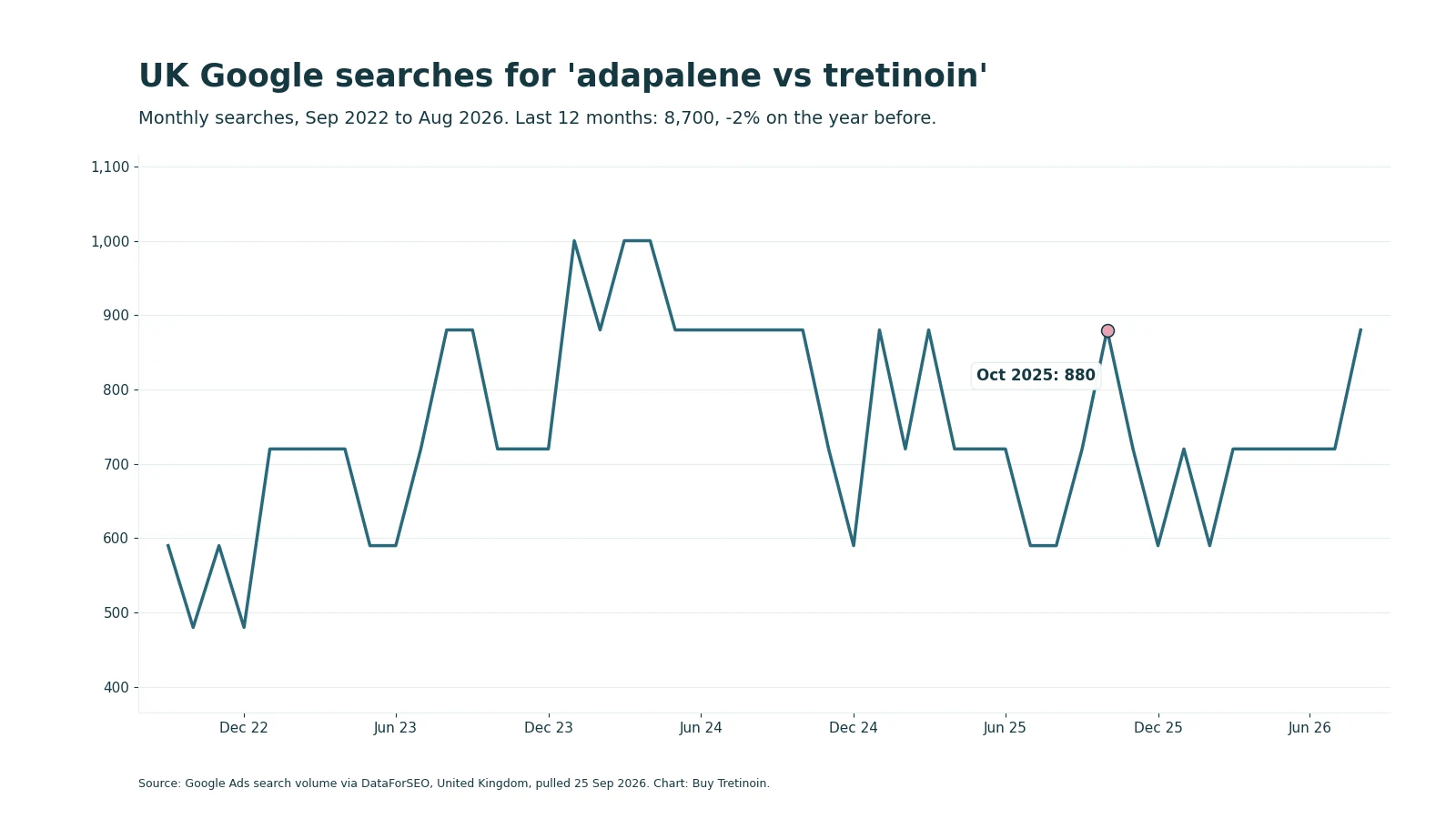
Our analysis of UK Google search data recorded 8,700 searches for the comparison query in the latest twelve months, against 8,890 in the year before. Google groups close variants into rounded buckets, so the figures help compare periods rather than count exact searches.
From our order data (Sep 2025 to Sep 2026): we sold 50 adapalene 0.1% gel units and 1,588 tretinoin units, about 1 adapalene unit for every 32 tretinoin units. This is one store, UK customers, and unit counts rather than people. December 2025 has no orders, which may reflect a store closure or a data gap.
The order figures describe one store, so they do not show which treatment works better or what UK patients generally use. Search interest for adapalene vs tretinoin was 8,700 in the latest 12 months, down 2% from 8,890 in the year before. This small fall points to steady demand for comparison information.
Adapalene purge, side effects and the adjustment period
Comparative studies recorded dryness, redness, scaling, stinging and burning. Several found less irritation with adapalene, while results also differed between tretinoin formulations. Your own response depends on the product and your skin.
An initial flare, sometimes called an adapalene purge, can be hard to distinguish from irritation or worsening acne. Note your symptoms and ask your prescriber or pharmacist if you are unsure. Our tretinoin purge guide explains why a change in spots needs context.
Stop using the product and contact a GP, pharmacist or dermatologist if you develop:
- severe burning, swelling, blistering or painful skin;
- eye irritation, facial swelling or a rash that is spreading;
- worsening acne with deep, painful lesions or signs of scarring;
- irritation that persists or makes normal skin care difficult.
Do not use adapalene or tretinoin if you are pregnant or trying to conceive. Speak with your prescriber about alternatives (NHS advice on medicines in pregnancy).
Switching from adapalene to tretinoin, or back
Your prescriber can advise whether to change treatment if irritation is difficult to manage or acne remains active. They can weigh your current routine and medical history.
- Tell your prescriber what you use, including strength, formulation, how often you apply it and any other acne products.
- Describe the result and any irritation, including when it started and whether it is settling.
- Ask whether to stop, switch or review the diagnosis before changing anything.
- Follow the new prescription and leaflet. Ask what to do if irritation returns or you miss an application.
If you are considering adapalene vs retinol, note that retinol is a different, non-prescription cosmetic ingredient. A prescriber can explain how your medicines fit together. Do not start a second retinoid or alternate treatments without their advice.
Can you use adapalene and tretinoin together?
The studies reviewed here did not test adapalene and tretinoin used together. Using both retinoids may increase irritation. Ask your prescriber or pharmacist before combining them, or pairing either medicine with benzoyl peroxide or another acne treatment. One study tested adapalene with benzoyl peroxide; its results apply to the products studied (Tempark et al.).
Is adapalene a retinoid? Where to go from here
Adapalene is a synthetic topical retinoid used for acne. If you have a prescription, follow its instructions and speak to your prescriber before changing treatment. Moderate, severe or scarring acne needs medical review. Read how to get started with tretinoin or about azelaic acid with tretinoin. For neutral product information, see our adapalene gel and our tretinoin range.
Frequently asked questions
In adapalene vs tretinoin, is 0.1% adapalene stronger than 0.025% tretinoin?
A percentage alone cannot rank the strength of different medicines. In acne trials, adapalene 0.1% and tretinoin 0.025% had similar overall efficacy, and adapalene was often better tolerated. The products act differently, and the right option depends on your diagnosis, skin and treatment history. Ask your prescriber before changing a prescription.
Is adapalene a retinoid?
Yes. Adapalene is a synthetic topical retinoid used to treat acne. It differs chemically from tretinoin, which is retinoic acid. Both affect retinoid pathways in skin, and their concentrations do not give a direct strength comparison. In the UK, adapalene is prescription-only, so a prescriber should guide its use.
Can I switch from tretinoin to adapalene?
A switch may be appropriate, but ask the prescriber managing your acne how to make it. They can account for your current formulation, irritation, other medicines and treatment response. Do not apply both together or create your own alternating schedule. Seek advice if your skin is painful, swollen or persistently inflamed.
Which works faster for acne?
Some trials found adapalene 0.1% reduced acne lesions faster during the first week than tretinoin 0.025%. By twelve weeks, one trial found no significant difference between them. These results compare specific strengths and formulations. They do not predict an individual response or mean you should change treatment without your prescriber.
Is adapalene over the counter in the UK?
No. Adapalene is prescription-only in the UK, as is tretinoin. Both should be used under a prescriber’s direction. Overseas guidance may describe adapalene as an over-the-counter product; in the UK, it requires a prescription.
Can I use benzoyl peroxide with adapalene or tretinoin?
One study used adapalene with benzoyl peroxide. Its results apply to the products and routine tested. Ask your prescriber or pharmacist before combining acne medicines, follow the instructions for your own products, and contact them if irritation is severe or persistent.
How we wrote this
We used the linked PubMed abstracts for the study findings. Our search analysis covers UK data from September 2022 to August 2026; our order figures cover one store from September 2025 to September 2026. Neither source measures treatment effectiveness or represents all UK patients. This post is general information, not medical advice. Last reviewed 25 September 2026. Corrections: support@buytretinoin.org.