- Tretinoin for Beginners: A Guide to Getting Started
- Should You Choose Cream or Gel?
- Which Strength is Right for You?
- Tretinoin for Sensitive Skin: How to Use It Safely
- Tretinoin for Acne
- Tretinoin for Hyperpigmentation
- Tretinoin for Wrinkles and Fine Lines
- Tretinoin for General Skin Texture
- Tretinoin for Sun Damage


Tretinoin Purge: How Long It Lasts and How to Tell It From a Breakout

Tretinoin purge usually describes a temporary rise in spots during the first weeks of treatment, often where acne already appears. The clinical evidence does not confirm that tretinoin causes this early flare.
People want to know whether to continue treatment or contact their prescriber. Acne can be hard to distinguish from irritation. Allergic reactions and perioral dermatitis can resemble both, so this guide explains what to watch for and when to seek advice.
What people mean by tretinoin purging
People use “purge” for a short-lived increase in acne after starting a retinoid. Online explanations often say tretinoin speeds skin cell turnover and brings blocked pores to the surface sooner. A review of trial data found no primary clinical-trial evidence that topical retinoids cause an initial flare. (Yentzer et al., 2009)
The label describes when spots appear after treatment starts. Familiar acne areas may fit the popular description; a widespread rash, burning, or peeling may suggest irritation or another condition. Searches for “tretinoin purge before and after” may suggest a predictable result, while the studies below report group lesion counts and do not establish a standard early flare.
The word “purge” describes early spots. A prescriber can assess whether they reflect acne changes or a reaction to treatment.
How long does the tretinoin purge last?
There is no confirmed purge timetable. Use the ranges to record changes. One adult acne trial found inflammatory lesion counts significantly lower at week two and total counts significantly lower by week four (Berger et al., 2007). Group averages cannot predict one person’s response.
| Time after starting | What you may notice | What to do |
|---|---|---|
| Weeks 0 to 2 | Dryness, redness, peeling, or familiar acne spots may appear. | Follow your prescriber’s directions and keep other new products out of the routine. |
| Weeks 2 to 6 | Existing acne may fluctuate; irritation can also become more noticeable. | Check whether spots stay in your usual acne areas and whether your skin feels sore or itchy. |
| Weeks 6 to 8 | Some people report gradual settling, while others see persistent acne or irritation. | Ask your prescriber or pharmacist if symptoms are worsening or hard to manage. |
| Weeks 8 to 12 | Acne treatment is assessed over time; a trial reported lesion-count outcomes at week 12 (Berger et al., 2007). | Arrange a review if you see no improvement or the pattern has changed. |
| After week 12 | Ongoing or new spots need a fresh look at the cause. | Seek advice about persistent acne, a rash, or spots in new areas. |
Use the table to record changes over time. “How long does tretinoin purge last” has no single evidence-based answer. The tretinoin side effects guide covers irritation in more detail.
What the clinical trials actually show
A 2009 review looked for trial data showing that topical retinoids initially worsen acne. The authors found no primary clinical-trial data supporting that belief. The data they reviewed suggested acne could improve during the first couple of weeks. They also noted that acne can worsen naturally during the first week or two, without the medicine causing it. (Yentzer et al., 2009)
Other studies measured acne lesions and skin reactions over set periods:
- A meta-analysis combined three vehicle-controlled trials of tretinoin microsphere gel in 629 people. It reported reductions in inflammatory and non-inflammatory lesions across 12 weeks. Erythema, peeling, and dryness were the most frequent adverse events. (Nighland et al., 2008)
- In a 12-week adult acne trial, inflammatory lesion counts were lower by week two. Total lesion counts were significantly reduced by week four. (Berger et al., 2007)
- A trial of clindamycin with tretinoin reported that irritation signs and symptoms were most noticeable at week two. The combination therapy and comparison groups limit how far its findings apply to tretinoin timelines. (Jarratt et al., 2012)
People may still see a flare-like change. Acne varies over time, and irritation can make skin look red or bumpy. A new cleanser, exfoliant, or acne medicine may also affect the skin. A careful symptom record can help a clinician assess these possibilities.
The studies measured average lesion counts and recorded irritation under specific trial conditions. They cannot confirm what is causing one person’s spots or predict their individual response.
Purge vs breakout: how to tell
Compare where spots appear, how they feel, and when the change began. Familiar acne may fluctuate; redness, itching, stinging, or peeling can point to irritation or allergy.
A contact allergy can look like irritation, and acne can occur alongside either. The NHS contact dermatitis guide describes itchy, blistered, dry, or cracked skin after contact with an irritant or allergen. DermNet describes periorificial dermatitis as papules around the mouth, nose, or eyes, sometimes sparing the skin next to the lips. (DermNet)
| Pattern | Where | When | What it may look or feel like | What to do |
|---|---|---|---|---|
| Possible purge-like change | Familiar acne areas | Often reported in the first weeks | Acne spots similar to your usual lesions | Track the change and ask your prescriber if it persists or worsens. |
| New breakout | New or usual acne areas | Can happen at any time | Blackheads, whiteheads, or inflamed spots | Consider recent routine changes and seek advice if persistent or painful. |
| Irritation or retinoid dermatitis | Areas where tretinoin is applied | Often early in treatment or after a routine change | Dryness, redness, stinging, or peeling | Contact your prescriber or pharmacist if uncomfortable or worsening. |
| Possible allergic reaction | Skin exposed to a product | May follow exposure to an irritant or allergen | Itchy, blistered, dry, or cracked skin | Stop the suspected new product and speak to a GP or pharmacist. |
| Possible perioral dermatitis | Around the mouth, nose, or eyes | Timing varies | Small papules; around the mouth, the lip edge may be spared | Ask a GP, pharmacist, or dermatologist to assess it. |
If you are unsure, note when the change began, which products you apply, and where symptoms appear. A clinician can review the pattern alongside your treatment.
How to get through the first 8 weeks
Use prescription tretinoin only as your prescriber directs, and ask before changing frequency or strength. General application guidance uses a pea-sized amount for the whole face. Your prescribed directions take priority. For example, the Treclin product information describes applying a pea-sized amount over the face. Formulations differ, so follow the leaflet supplied with your prescription and your prescriber’s directions.
- Ask your prescriber how often to start. Your prescriber may suggest starting a few evenings each week, depending on your skin and the formulation.
- Apply to clean, fully dry skin if that matches your prescribed directions. Damp skin can feel more sensitive for some users.
- Use a plain moisturiser. If your prescriber agrees, applying moisturiser before and after tretinoin may make the routine easier to tolerate.
- Wear broad-spectrum sunscreen during the day and follow the product and prescriber advice about sun exposure.
- Avoid picking spots. NHS advice says squeezing spots can worsen them and cause scarring.
- Avoid adding exfoliating acids, scrubs, or other new active products until you have checked with your prescriber or pharmacist.
For product texture guidance, see our guide to moisturisers to use with tretinoin and the morning and evening tretinoin routine. A beginner’s guide to tretinoin explains the prescription context and routine basics.
Why searches for “tretinoin purge” are falling
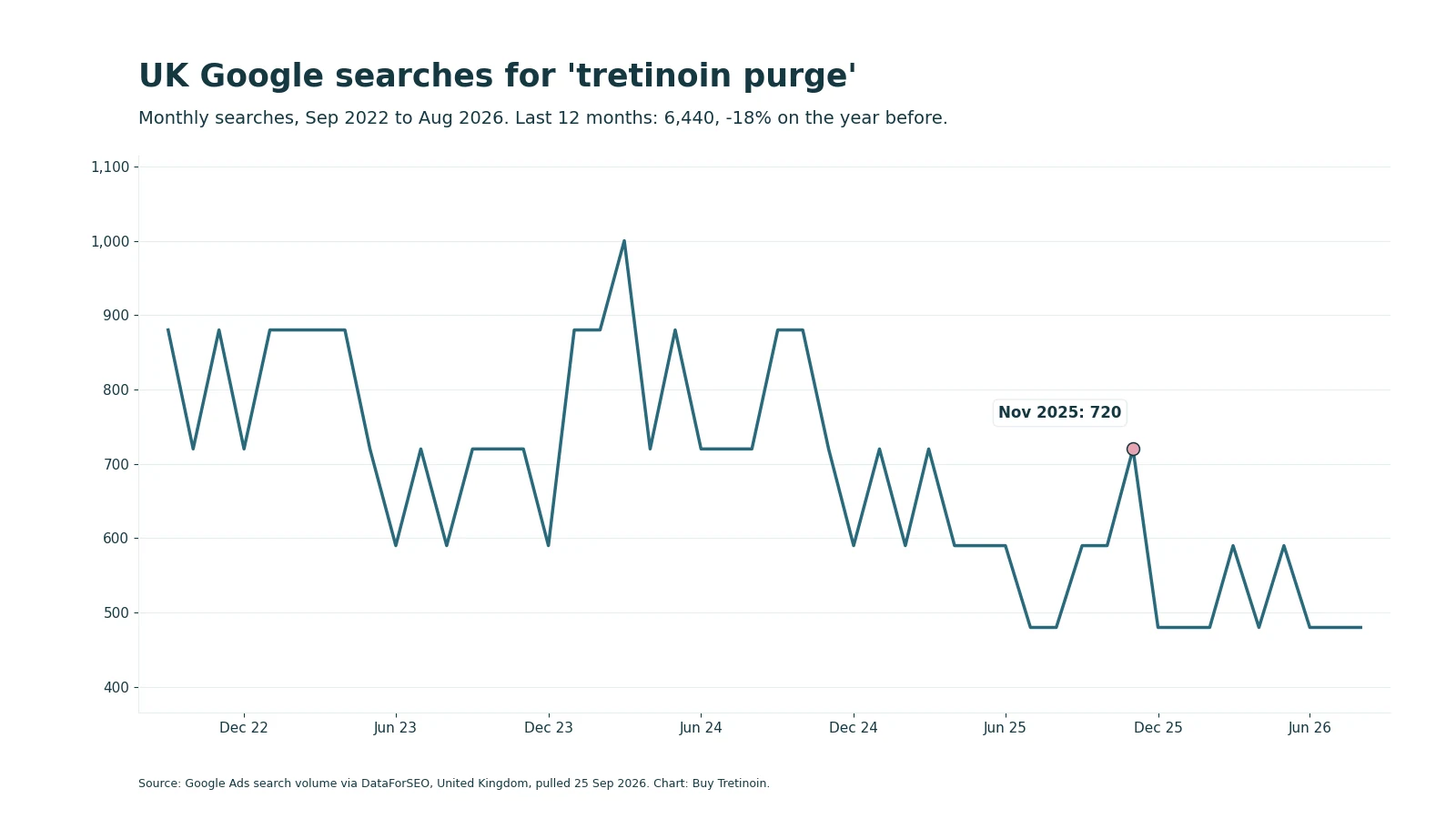
UK Google search estimates show 6,440 searches for the measured phrase in the 12 months to August 2026, compared with 7,830 in the preceding 12 months. Against September 2022 to August 2023, the total was down 31%. Over the same comparison, searches for “tretinoin before and after” rose 34%. Google reports rounded search volumes; they do not count people or diagnoses.
The chart shows monthly estimates across 48 months. Google groups close keyword variants into rounded volume buckets, which show broad changes better than exact demand. Search volume alone cannot explain why totals fell or whether fewer people experienced skin changes.
From our order data (Sep 2025 to Sep 2026): we sold 31 barrier repair creams to retinoid users; 949 tretinoin units were creams (60%). Source: WooCommerce order line items marked completed, processing or on-hold, 14 September 2025 to 14 September 2026; pulled 14 September 2026. One store, UK customers, 12 months; unit counts do not identify people. December 2025 had no orders, possibly because the store was closed or because of a data gap.
These order figures describe purchases at one store. They do not show how customers used the products or whether a moisturiser changed their skin.
Does adapalene or Retin-A cause a purge too?
Adapalene is also a topical retinoid used for acne, and online discussions use “adapalene purge” in a similar way. The evidence pack includes trials comparing adapalene with tretinoin, but those trials measured lesion counts and tolerability. They do not establish a standard purge or prove that either medicine causes an initial flare. (Grosshans et al., 1998; Caron et al., 1997)
“Retin-A” is a brand name commonly used for tretinoin in search queries. A retin a purge is still an informal label, not a diagnosis. Read our comparison of adapalene and tretinoin and discuss any treatment change with the prescriber responsible for your care.
Tretinoin, adapalene, and tazarotene should not be used during pregnancy or while trying to conceive. Contact your prescriber for advice if this applies to you.
When to stop or see someone
Contact your GP, pharmacist, or dermatologist if the skin reaction is severe, keeps worsening, or does not settle. Seek advice promptly for swelling, blistering, a widespread rash, or symptoms around the eyes. Do not keep applying tretinoin to broken or very sore skin without advice.
Arrange a review if spots spread to areas where you do not usually get acne, persist beyond the expected review period, or become painful cysts. A clinician can also check for perioral dermatitis, allergy, or another cause. Tretinoin is a UK prescription-only medicine, so follow your prescriber’s directions and do not change your treatment plan based on a web article.
- Stop using a newly added cosmetic if you suspect it triggered a rash, then ask a pharmacist or GP what to do next.
- Contact your prescriber about changing frequency, strength, or whether to pause treatment.
- Seek urgent medical help for a severe allergic reaction, breathing difficulty, or rapidly worsening swelling.
See the side effects and management guide for more on common reactions. For decisions involving pregnancy, eye symptoms, broken skin, or another prescription medicine, speak with a healthcare professional.
Where to go from here
If dryness is your main concern, compare options in our barrier cream range for retinoid users.
Our posts on tretinoin before and after and azelaic acid with tretinoin cover related questions. Check with your prescriber before combining active treatments.
Frequently asked questions
What week is the tretinoin purge worst?
Trials have not identified a week when a tretinoin purge is worst. People sometimes report more spots in the first few weeks, although a 2009 review found no primary clinical-trial evidence that topical retinoids cause an initial acne flare. Ask your prescriber or pharmacist for advice if spots are painful, spread to new areas, or come with a sore rash.
Is it normal to purge on tretinoin?
Some people report more spots soon after starting tretinoin, often in areas where they already get acne. A review of trial data found no primary clinical-trial evidence for a retinoid-caused flare. Irritation and ordinary acne changes can look similar. Describe where the spots appear and how your skin feels, then ask your prescriber if the change persists or worsens.
Can you purge twice on tretinoin?
Research in the evidence reviewed here does not establish a second tretinoin purge as a recognised pattern. Spots that return after settling may relate to acne itself, a change in routine, irritation, or another cause. Note when the change began and where it appears, then ask the prescriber who manages your treatment if it persists or worsens.
Should I stop tretinoin during a purge?
Do not change a prescription tretinoin plan solely because a website labels spots a purge. Contact your prescriber or pharmacist if irritation is difficult, symptoms are worsening, or you are unsure whether to continue. Stop and seek prompt advice for swelling, blistering, eye symptoms, or a severe rash. Follow the instructions supplied with your prescription.
Does a lower strength mean less purging?
The studies listed here do not establish that a lower tretinoin strength prevents a purge. They examine acne lesion counts and irritation under particular study conditions, not a personalised strength choice. Ask your prescriber whether strength or frequency should change, especially if you have persistent redness, peeling, burning, or new acne outside your usual areas.
When do tretinoin uglies go away?
“Tretinoin uglies” is an informal phrase for early spots or irritation. It has no fixed medical meaning or end date. Some flare-like changes may settle over weeks, while trials have not confirmed a standard purge timeline. Ask a GP, pharmacist, or dermatologist to review a rash, spots in new areas, or symptoms that keep worsening.
How we wrote this
We reviewed the PubMed abstracts cited above, including the review by Yentzer and the studies by Nighland, Berger, Jarratt, Grosshans, and Caron. We analysed UK Google search data from September 2022 to August 2026 and our order data from September 2025 to September 2026. Search estimates are rounded, and order units cannot identify people, diagnoses, or product outcomes. Trial averages cannot predict an individual response. This article is general information, not medical advice. Last reviewed 25 September 2026. Corrections: support@buytretinoin.org.