- Tretinoin for Beginners: A Guide to Getting Started
- Should You Choose Cream or Gel?
- Which Strength is Right for You?
- Tretinoin for Sensitive Skin: How to Use It Safely
- Tretinoin for Acne
- Tretinoin for Hyperpigmentation
- Tretinoin for Wrinkles and Fine Lines
- Tretinoin for General Skin Texture
- Tretinoin for Sun Damage


Tretinoin Before and After: What Changes, Month by Month

Tretinoin before and after results take weeks or months to assess. Acne studies measure changes over 8 to 12 weeks. Photoageing trials follow fine lines and pigmentation for several months. Your response also depends on the reason for treatment, the formulation and whether irritation makes it hard to continue.
One acne study assessed improvement after a mean of 12 weeks. Photoageing trials measured outcomes from 16 to 48 weeks. These timings describe when researchers assessed participants. These timings describe study assessments, not a deadline for an individual result. For advice on starting safely, read our guide to starting tretinoin.
What tretinoin results can look like at each stage
The timeline shows when studies assessed tretinoin before and after changes for acne, fine lines and pigmentation. Acne studies measured lesions over weeks, while wrinkle and pigmentation trials generally ran longer. Trial photographs record group outcomes under controlled conditions; individual results vary.
| Stage | Acne | Fine lines | Pigmentation | Texture | What may be normal |
|---|---|---|---|---|---|
| Weeks 1 to 2 | Too early to judge a lasting change | Too early to judge | Too early to judge | Skin may feel drier or rougher if irritated | Dryness, stinging or redness can occur |
| Weeks 2 to 6 | Track new and existing lesions over time | Usually early for a visible change | Usually early for a visible change | Irritation can affect how skin looks | One study reported that initial irritation eased after about a month (PMID 35674757) |
| Weeks 6 to 12 | Acne trials record lesion changes across this period (PMID 23167277) | Early photoageing changes may be subtle | Marks can fade at different rates | Compare photos rather than daily impressions | Ask for advice if irritation persists |
| 3 to 6 months | Continue judging against the treatment plan | Trials measured wrinkle and overall photoageing changes by 16 to 24 weeks (PMID 3336176, PMID 1552056) | Pigment outcomes were assessed over 40 weeks in one trial (PMID 8277035) | Some studies used clinical grading and skin-surface measurements | Redness or peeling still needs review if troublesome |
| 6 to 12 months | Your prescriber can review whether the plan is helping | A 48-week trial compared two strengths for photoageing (PMID 7544967) | Longer follow-up may help assess persistent marks | Biopsy findings describe tissue changes; photographs assess visible changes | Keep follow-up appointments and use sun protection |
A clinical trial of tretinoin 0.05% cream followed 296 people with photodamaged facial skin for 24 weeks. At the end, 68% of the tretinoin group and 43% of the vehicle group showed improvement; the researchers also reported better fine wrinkling, mottled pigmentation and roughness in the tretinoin group (Olsen et al., PMID 1552056). That comparison applies to this formulation and condition.
Lighting, irritation, other treatments and natural variation can all affect how skin looks from week to week, so a timeline alone cannot identify what caused a change.
Why UK searches for tretinoin before and after peak in January
Our analysis of UK Google search data recorded 45,700 searches for this query from September 2025 to August 2026. The previous 12 months recorded 36,600. That is a 25% year-on-year increase, while the total was 34% above September 2022 to August 2023. Search volumes are rounded Google Ads buckets, so they show demand patterns rather than exact counts of people.
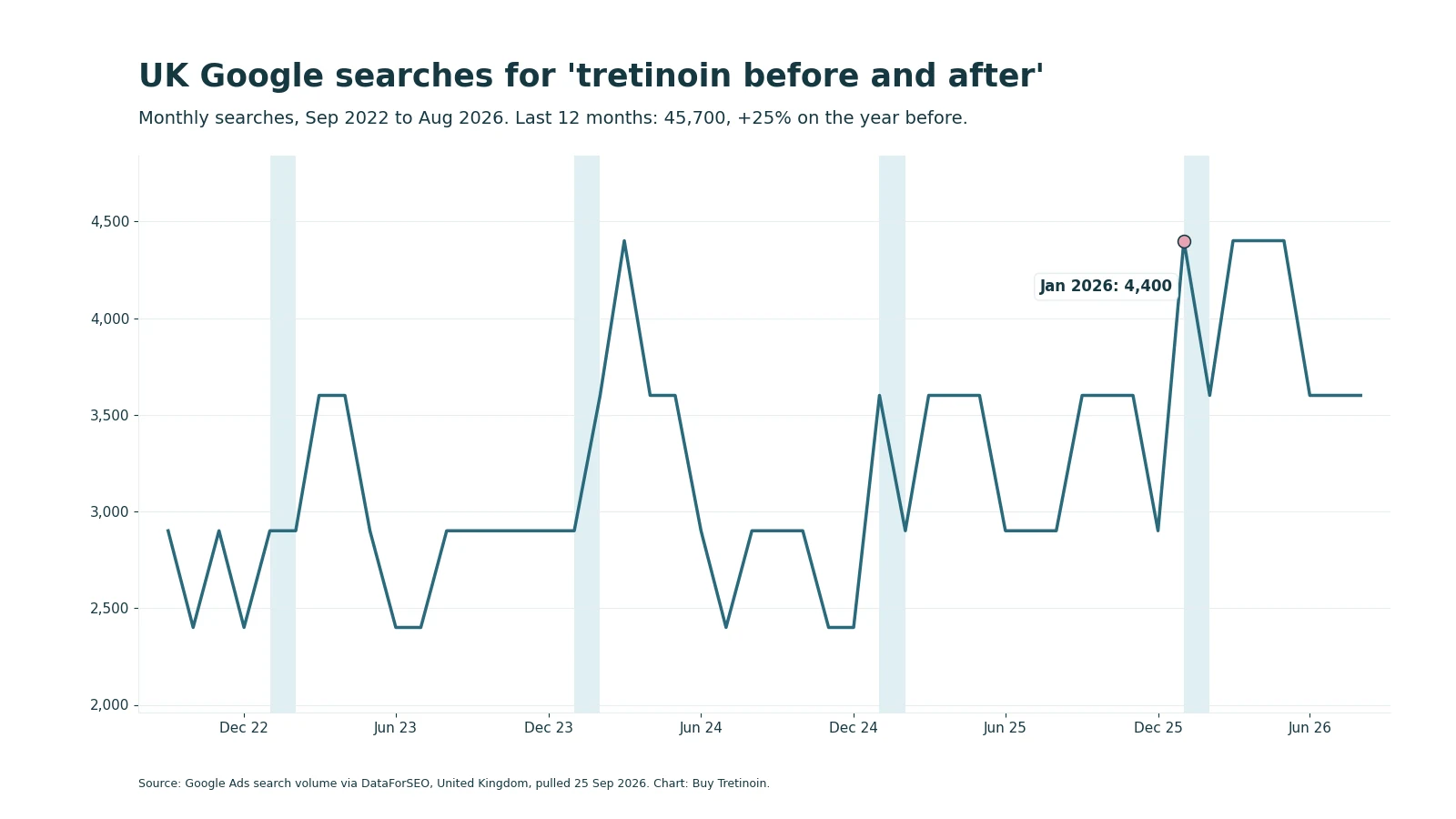
January was the highest single month in the latest 12-month period. This seasonal rise cannot show when people start treatment. Someone who begins in winter may reach a 12-week review in spring. Search data cannot tell us whether a person started treatment, received a prescription or saw a change in their skin.
Retin A cream before and after: what clinical trials measured
Retin-A is a brand name for tretinoin. Studies behind retin a before and after photographs measured different outcomes, including clinical scores, skin-surface changes and tissue samples. Each study addressed a specific question, which makes results from different photographs hard to compare.
The studies cited here assessed:
- Fine and coarse wrinkling, skin looseness, sallowness and hyperpigmentation in standardised photographs over six months (Leyden et al., PMID 2674225).
- Overall photoageing, fine wrinkling, mottled pigmentation and roughness after 24 weeks, alongside histology of epidermal thickness and melanin content (Olsen et al., PMID 1552056).
- Pigmented lesions through clinical grading, colour measurement and biopsy in a 40-week trial (Griffiths et al., PMID 8277035).
- Epidermal thickness, vascularity and irritation in a 48-week comparison of 0.1% and 0.025% tretinoin (Griffiths et al., PMID 7544967).
- Epidermal atypia and collagen thickness in an open study of daily treatment for at least six months (Cho et al., PMID 16243124).
In the 48-week comparison, both strengths improved photoageing scores. Epidermal thickness increased by 30% with 0.1% and 28% with 0.025%; the vehicle group had an 11% decrease. The higher concentration caused more erythema and scaling, with no clinically or statistically significant difference in efficacy between strengths (PMID 7544967).
Biopsies measured tissue changes, including epidermal thickness. Trial photographs recorded visible changes, and neither measure predicts an individual response.
Does a stronger tretinoin give a better before and after?
A higher concentration produced no greater photoageing improvement in the 48-week comparison. Participants using 0.1% had more erythema and scaling than those using 0.025%. Both groups improved similarly compared with vehicle (PMID 7544967). The comparison covered this study population, cream formulation and treatment period.
From our order data (Sep 2025 to Sep 2026): 0.1% made up 53% of tretinoin units and 0.025% made up 19%. These figures cover one UK store over 12 months and count units rather than people. There were no orders in December 2025, which may reflect a store closure or a gap in the data.
The store figures show what customers bought. A prescriber chooses a strength based on the reason for treatment, your skin and how it tolerates treatment. Our tretinoin strengths guide explains the available concentrations. If you are comparing ingredients, read tretinoin vs retinol before discussing options with a prescriber.
Before and after by concern
Tretinoin before and after changes depend on the concern being assessed. Acne studies count lesions, while photoageing studies assess wrinkles, pigmentation and texture. The sections below summarise what researchers measured and how far each result can be applied.
Tretinoin before and after acne
Acne studies count lesions and use grading systems. In one small, open multicentre study, 74 people used 0.05% tretinoin cream as short-contact therapy. Treatment lasted 8 to 32 weeks, with a mean of 12 weeks; 41 participants had at least 50% clinical improvement from baseline (PMID 23167277). The design and method limit how widely that result can be applied. For a worsening flare, see our guide to the tretinoin purge.
Tretinoin before and after aging: fine lines and wrinkles
Tretinoin before and after wrinkles are assessed through photographs, clinical grading or skin casts. In a six-month vehicle-controlled trial, researchers reported improvement in fine wrinkling as well as other signs of photodamage (PMID 2674225). An open study of 34 people using 0.05% daily for at least six months found that the measured collagen band doubled. Visible wrinkle change was not reported as a percentage (PMID 16243124). Read more about tretinoin for fine lines and wrinkles.
Hyperpigmentation: tretinoin before and after
For a search such as “hyperpigmentation tretinoin before and after”, the type of mark matters. This trial assessed photoageing-related pigmented lesions in Chinese and Japanese participants.
After 40 weeks, lesions were lighter or much lighter in 90% of the tretinoin group and 33% of the vehicle group. Biopsies showed a 41% decrease in epidermal pigmentation with tretinoin and a 37% increase with vehicle (PMID 8277035). This result is specific to the study and does not predict how other marks will respond. Our article on tretinoin for hyperpigmentation covers the distinction.
Texture and pores
Trials measured roughness and skin surface with clinical grading or casts. Olsen and colleagues reported greater improvement in roughness with 0.05% tretinoin than vehicle after 24 weeks (PMID 1552056). Pore appearance was not a main outcome in the trials above. A close-up can also exaggerate texture when light comes from the side.
Why before and after photos can mislead
Before and after photos are easier to compare when the conditions stay consistent. Changes in light, distance or camera processing can make texture, redness and pigmentation look more or less pronounced.
- Lighting from a window or overhead bulb changes shadows and apparent redness.
- A closer camera angle makes pores and fine lines look larger.
- Retouching, filters or different phone processing can smooth the skin.
- Other treatments used at the same time can contribute to a change.
- A selected date may capture a temporary flare or a particularly calm day.

Clinical studies used standardised photographs or measurements to reduce these differences. Researchers also considered other outcomes alongside the images. Trial pictures show participants in those studies; individual results vary.
How to take your own before and after photos
Use the same simple setup at regular intervals. Photos can help you compare changes in your skin. Use photos to track appearance over time, and get a clinical review for a reaction.
- Stand in the same place near the same window.
- Take each photo at the same time of day and from the same distance.
- Use a bare face without makeup, and keep the camera angle steady.
- Take a set every four weeks rather than checking the camera daily.
- Add a short note from 1 to 10 for dryness, redness or acne, using the same scale each time.
Compare photos in similar light and focus on one concern at a time. If irritation changes how your skin looks, record it beside the photo so you can distinguish it from other changes.
What can slow results down
Irritation can make treatment difficult to continue. Adding several strong products at once can also make it harder to identify the cause of a reaction. Applying tretinoin to damp skin may increase irritation for some people. Follow your prescriber’s instructions and ask before changing your routine.
Daily sun protection helps limit further sun damage. Avoid adding exfoliating acids or other retinoids unless your prescriber says they fit your plan. For delicate eye-area concerns, read tretinoin under the eyes. For body skin, see the guide to tretinoin for stretch marks.
Tretinoin is a prescription-only medicine in the UK and should be used with a prescriber’s direction. Do not use it during pregnancy or while trying to conceive. Stop applying it and contact a GP, pharmacist or dermatologist if you have:
- Severe or persistent burning, redness or irritation.
- Painful swelling, blistering, or open or broken skin.
- Eye symptoms after applying tretinoin.
Where to go from here
If a prescriber recommends tretinoin, agree a review point and a plan for irritation before starting. Our guide to how long tretinoin takes to work explains why assessment periods vary by concern. Persistent or scarring acne, unexpected pigment changes, pregnancy or eye symptoms need individual medical advice.
For neutral product information, see our tretinoin range or our guide to tretinoin cream in the UK. Any product choice should follow a prescription and clinical advice.
Frequently asked questions
How long does it take for tretinoin to work?
Acne improvement is usually assessed over weeks, while fine lines and sun-related pigmentation take several months to measure. In one small, open study, 41 of 74 people using short-contact tretinoin had at least 50% clinical improvement after a mean of 12 weeks. Individual tretinoin results vary, and that study cannot predict one person’s response. Read our guide to how long tretinoin takes to work.
Is 40 too late to start tretinoin?
Age alone does not set a cut-off. Trials of photoaged skin included adults across a range of ages, and one study in older adults recorded structural changes after treatment. Suitability depends on your skin, health and reason for treatment. Tretinoin is prescription-only in the UK, so discuss whether it is appropriate with a prescriber.
Does tretinoin make wrinkles go away?
Tretinoin can improve some signs of photoageing, including fine wrinkling, in clinical studies. It does not erase every wrinkle, and study results vary by concentration, treatment duration and the skin assessed. In a 6-month trial, researchers compared standardised photographs and wrinkle grades. Any expected benefit should be discussed with the prescriber who recommends treatment.
Can tretinoin age you faster?
There is no result in the studies cited here showing that prescribed tretinoin accelerates skin ageing. Early dryness, redness or peeling can make skin look temporarily rough or lined. Persistent irritation needs medical advice because the treatment may need to be reviewed. Use sun protection and follow the instructions from your prescriber.
Why does my skin look worse after starting tretinoin?
Dryness, redness, stinging and peeling can occur when skin is irritated. Acne may also fluctuate while treatment is starting, but a severe or persistent flare should be assessed. Stop and seek advice for painful swelling, blistering, marked skin breakdown or eye symptoms. A GP, pharmacist or dermatologist can help decide what to do next.
Do results last if I stop?
The studies in this article measured changes during tretinoin treatment. They offer no follow-up evidence on how long visible changes last after treatment ends. Skin continues to age and respond to sun exposure over time. Ask your prescriber before changing or stopping a prescription, especially if it was prescribed for acne or another skin condition.
How we wrote this
We checked the linked PubMed abstracts on acne, photoageing, wrinkles and pigmentation. We reviewed UK Google search data from September 2022 to August 2026 and our order data from September 2025 to September 2026. Search estimates use rounded monthly buckets. Store units do not identify individual customers. These sources describe group results and search patterns, not an individual response or reason for starting treatment. This article provides general information, not medical advice. Last reviewed 25 September 2026. Corrections: support@buytretinoin.org.