- Tretinoin for Beginners: A Guide to Getting Started
- Should You Choose Cream or Gel?
- Which Strength is Right for You?
- Tretinoin for Sensitive Skin: How to Use It Safely
- Tretinoin for Acne
- Tretinoin for Hyperpigmentation
- Tretinoin for Wrinkles and Fine Lines
- Tretinoin for General Skin Texture
- Tretinoin for Sun Damage


Tretinoin and Minoxidil for Hair Loss: Does the Combination Work?


Tretinoin and minoxidil may help some people with pattern hair loss, but evidence for the combination remains limited. One small trial in men found no statistically significant difference between a prepared solution used once daily and 5% minoxidil used twice daily. With only 31 participants, it was too small to establish equivalence (Shin et al.).
Shin’s scalp study used a prepared solution. A face cream has a different formulation, so it should not be used as a scalp treatment. In the UK, tretinoin is prescription-only.
Why people add tretinoin to minoxidil
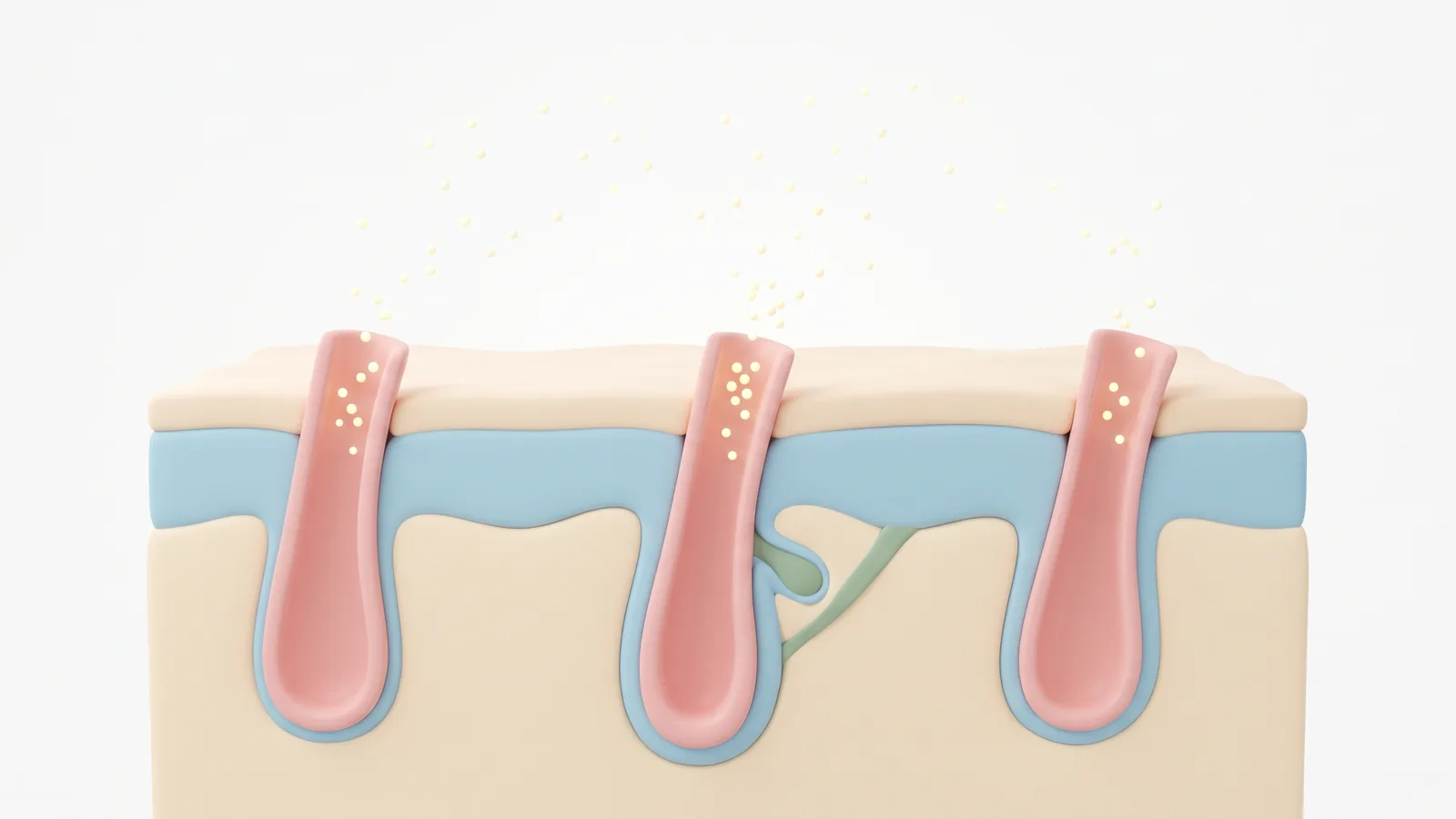
Topical minoxidil becomes active after follicular sulfotransferase converts it into minoxidil sulfate. Tretinoin may affect that step. In one study, follicular sulfotransferase activity predicted response to topical minoxidil (Goren et al.). That finding helps explain why researchers have studied the combination.
Sharma and colleagues studied whether tretinoin changed this enzyme activity. In their cohort, 43% of participants initially predicted to be non-responders were classed as responders after 5 days of topical tretinoin (Sharma et al.). This was a short study of a predicted response. It does not show that everyone will see more hair growth.
Minoxidil needs conversion to minoxidil sulfate before it can act:
- Topical minoxidil is applied to the scalp.
- Follicular enzymes convert some minoxidil into minoxidil sulfate, its active form.
- Tretinoin may affect enzyme activity or how minoxidil passes through the skin.
Researchers have examined both skin penetration and enzyme activity. Their relative effects remain unclear. A 2026 review found little clinical evidence and did not support routine first-line use of the combination (Maas et al.).
What studies say about minoxidil and tretinoin
The studies provide limited evidence that tretinoin improves minoxidil treatment. A randomised trial in 31 men found no statistically significant difference between a combined solution used once daily and 5% minoxidil used twice daily (Shin et al.). Other studies report preliminary hair growth or changes in predicted response, rather than clear evidence of long-term benefit.
| Study | Design and participants | Treatment or finding | What it can tell us |
|---|---|---|---|
| Bazzano, 1986 (PMID 3771854) | Clinical trial; 56 people with androgenetic alopecia | After 1 year, terminal hair regrowth was reported in 66% with the combination; approximately 58% had some regrowth with tretinoin alone. The abstract describes these as preliminary results. | Preliminary findings; the abstract calls for more research. |
| Shin, 2007 (PMID 17902730) | Randomised comparative trial; 31 men | 5% minoxidil with 0.01% tretinoin once daily was compared with 5% minoxidil twice daily. The trial found no statistically significant differences in measured hair-count outcomes or subjective assessments. Itching or local irritation affected 4 of 14 people using minoxidil alone and 5 of 15 using the combination. | A small trial of a prepared once-daily solution; it gives no home-mixing instructions. |
| Sharma, 2019 (PMID 30974011) | Follicular enzyme study in people with androgenetic alopecia | After 5 days of tretinoin, 43% of those initially predicted to be non-responders were classed as responders. | Supports a possible enzyme mechanism; it does not settle long-term benefit. |
| Maas, 2026 (PMID 42535115) | Review of topical combination evidence | The review describes minimal clinical data and reports nearly threefold higher systemic absorption when tretinoin cream was applied before minoxidil. | A review, not a new treatment trial; absorption and irritation need consideration. |
| Olsen, 2002 (PMID 12196747) | Randomised trial; 393 men | Over 48 weeks, 5% topical minoxidil produced 45% more hair regrowth than 2% in the trial. | Context on minoxidil strength; it did not test tretinoin. |
| Lucky, 2004 (PMID 15034503) | Randomised trial; 381 women | Over 48 weeks, 5% minoxidil was superior to placebo on the primary measures. Irritation and hypertrichosis occurred more often than with 2% or placebo. | Context on minoxidil in women; it did not test tretinoin. |
| Penha, 2024 (PMID 38598226) | Randomised trial comparing oral and topical minoxidil in men | Oral 5 mg daily did not demonstrate superiority over topical 5% twice daily in this study. | It did not test tretinoin, so it cannot answer whether a topical combination helps. |
The evidence has clear limits:
- The combination trial was small and studied one prepared solution in men. The enzyme study measured a predicted response, not visible hair growth over time.
- The older trial used a formulation and minoxidil strength that should not be copied as a recipe.
The review says clinical data remain minimal and does not support the combination as a first-line option (Maas et al.).
Why UK searches for tretinoin and minoxidil rose after 2022
Our analysis of UK Google search data recorded 7,310 searches for “tretinoin and minoxidil” from September 2025 to August 2026, up 8% from 6,760 the year before and 215% from 2,320 in September 2022 to August 2023. January 2026 was the latest period’s peak, at 1,000 searches.
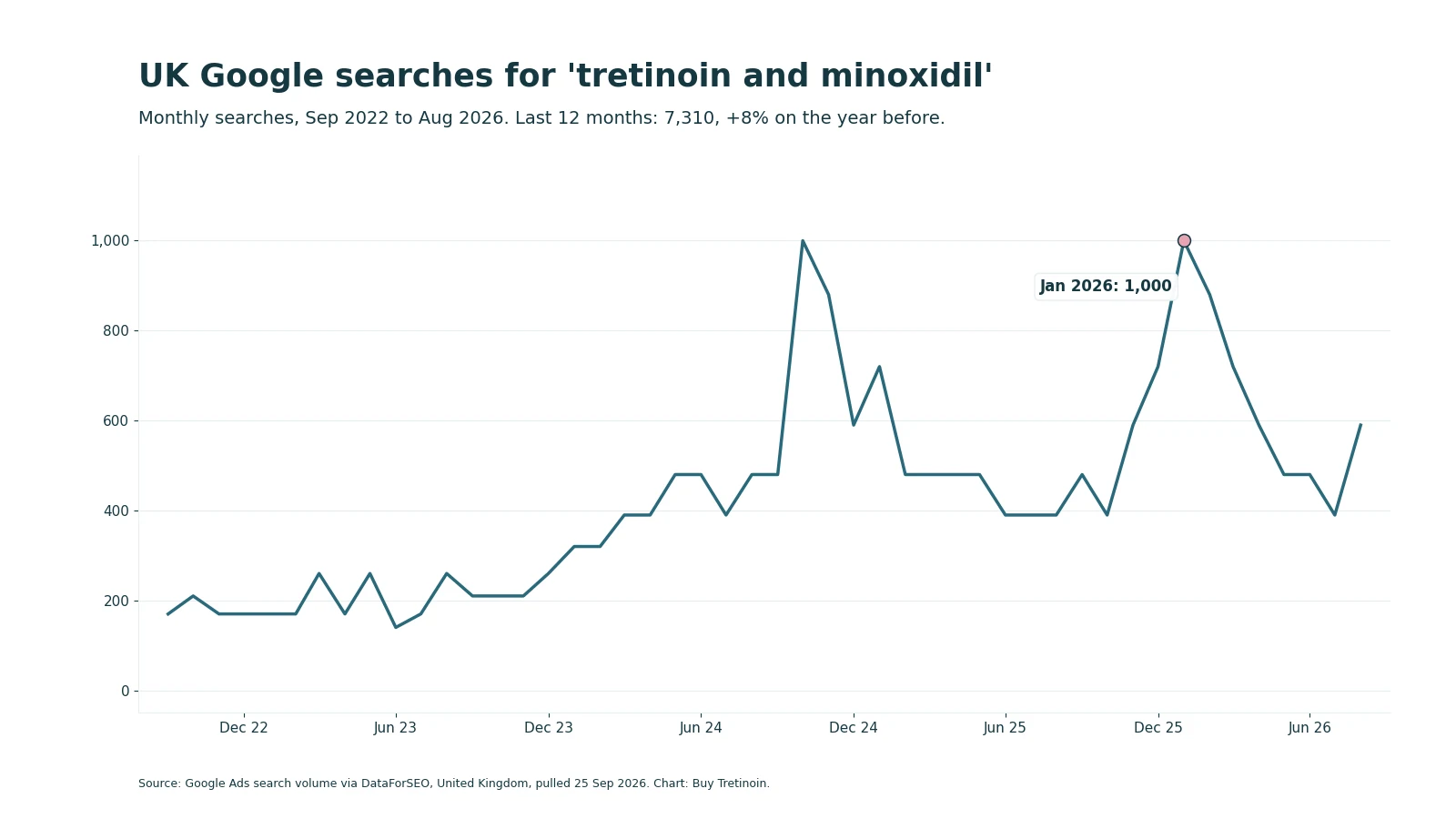
Google rounds search volumes and groups close variants. The figures show more recorded searches for the phrase across these periods. They do not tell us why people searched, whether they used the treatment or what happened after use. January’s peak is one month in this series, not evidence of a lasting trend.
The strength gap between scalp formulas and face creams
The scalp studies used prepared tretinoin solutions. Shin’s randomised trial used a 0.01% solution with minoxidil (Shin et al.). Facial creams have different formulations, and the percentage on a tube cannot establish whether a product is suitable for the scalp.
| Product or study context | Tretinoin strength | Where it was used or studied |
|---|---|---|
| Shin combination trial | 0.01% | Prepared scalp solution with 5% minoxidil, applied once daily in the trial. |
| Bazzano combination trial | Not stated in abstract | Tretinoin with 0.5% minoxidil; the abstract does not give tretinoin strength. |
| Facial tretinoin creams | Varies by product | Formulated for skin; not evidence for scalp use. |
The 2026 review reports nearly threefold higher systemic absorption when tretinoin cream was applied before minoxidil. Its abstract does not show what that means for every product or person (Maas et al.).
Do not turn a face cream into a scalp treatment or mix it into minoxidil at home. Ask a prescriber whether a scalp formulation is suitable and how to use it.
How to use minoxidil with tretinoin safely
A prescriber may recommend a prepared scalp solution, as in the Shin trial, or give directions for separate products. The studies do not set a standard interval between separate applications. Ask the prescriber or dispensing pharmacist how to use your exact preparation, including whether the first product must dry before you apply the next.
Tretinoin is prescription-only in the UK. A prescriber needs to decide whether a combination is appropriate, and a pharmacist can clarify the directions on a dispensed treatment. Do not use a facial cream as a scalp formula or prepare a mixture yourself.
Combination preparations vary in strength and directions. People searching “how to use tretinoin cream and minoxidil” may be considering separate products. Evidence from specific prepared solutions cannot provide a home-mixing ratio or a general waiting time. If you already use minoxidil, follow its label or your clinician’s instructions while you ask about a change.
Side effects and who should avoid it
Scalp irritation is a concern with both treatments, and tretinoin may increase minoxidil absorption. In the Shin trial, itching or local irritation affected 4 of 14 people using minoxidil alone and 5 of 15 using the combination (Shin et al.). A separate trial found more irritation with 5% than 2% minoxidil in men (Olsen et al.).
A 2026 review reports nearly threefold higher systemic absorption when tretinoin cream was applied before minoxidil. It also describes tolerability concerns (Maas et al.). Before changing treatment, ask a GP, pharmacist or dermatologist if you have a heart condition, scalp inflammation, broken skin or a history of reactions. Women concerned about unwanted facial hair should ask for advice. In a trial of women, hypertrichosis was more common with 5% than with 2% minoxidil or placebo (Lucky et al.).
Tretinoin should not be used in pregnancy or when trying to conceive.
When to stop and seek advice
Stop applying the products and contact a GP, pharmacist or dermatologist if you develop:
- Persistent burning, marked redness, swelling, blistering or painful scalp irritation.
- Sudden, patchy or worsening hair loss, especially with scalp pain or inflammation.
- Symptoms that concern you after application, including a possible reaction beyond the scalp.
If you have a heart condition or take medicines that may affect blood pressure, discuss minoxidil with a clinician before starting or changing it. Do not stop or alter prescribed medicines without their advice.
Tretinoin for hair loss on its own?
Evidence for tretinoin used alone consists of preliminary findings and one case report. An older trial reported some regrowth and called for further research (Bazzano et al.). A case report described improvement in a rare inherited condition after combined topical treatment. It cannot establish benefit for common pattern hair loss (Melkote et al.).
The available evidence does not establish tretinoin alone as an alternative to minoxidil for androgenetic alopecia. Tretinoin is prescription-only in the UK. Discuss the diagnosis and treatment choices with a prescriber before considering it for hair loss.
Discuss hair loss and treatment with a clinician
A GP or dermatologist can assess new, sudden or patchy hair loss before you change treatment. If you already use minoxidil, ask a pharmacist or prescriber which strength and preparation are suitable before adding tretinoin.
Our guide explains how to use a 10% minoxidil solution, and another covers why consistent minoxidil use matters.
For skin-related reading, see our articles on tretinoin before and after and the tretinoin purge. The purge article concerns facial skin, not scalp treatment. Our 10% minoxidil solution has product directions. Ask a prescriber or pharmacist whether it suits your circumstances.
From our order data (Sep 2025 to Sep 2026): we sold 42 units of 10% minoxidil solution and 1,588 tretinoin units. The line items are dated 14 September 2025 to 14 September 2026 and were pulled on 14 September 2026. This covers one store and UK customers over 12 months. Units are not people. December 2025 has no orders in the data, due to a store closure or data gap.
These figures describe orders in our shop. They do not show which products people used for hair loss or whether a treatment worked.
Frequently asked questions
Does tretinoin and minoxidil work for hair loss?
Tretinoin and minoxidil may help some people with androgenetic alopecia, but evidence is limited. A small trial in men found no statistically significant difference between a once-daily combined solution and 5% minoxidil used twice daily. Another study found that some people predicted not to respond to minoxidil became responders after tretinoin. These findings do not establish a standard treatment for everyone.
How long should I wait after applying tretinoin to apply minoxidil?
Wait until the first product is fully dry before applying another topical product, unless your prescriber gave different instructions. The studies do not establish a universal waiting interval for separate products. Ask the prescriber or dispensing pharmacist about your exact preparation, and avoid applying it to irritated skin.
Is minoxidil with tretinoin available in the UK?
Availability depends on the product and prescriber. Tretinoin is a prescription-only medicine in the UK, so a combined or compounded treatment needs a prescriber’s decision. Ask a GP, pharmacist or dermatologist whether a suitable prescribed option is available for you. Do not mix separate products at home.
Can I put my tretinoin face cream on my scalp?
Do not use a tretinoin face cream as a scalp treatment unless a prescriber specifically directs you to. The published scalp studies used different formulations and lower tretinoin strengths than many face creams. A cream may also irritate the scalp or change how minoxidil is absorbed.
Does tretinoin cause hair shedding?
The studies in this article do not establish that tretinoin itself causes a predictable shedding phase. Hair changes can have several causes, and irritation or worsening loss needs individual assessment. Contact a GP, pharmacist or dermatologist if shedding is sudden, patchy, severe or accompanied by scalp pain or inflammation.
Is 10% minoxidil better than 5%?
The abstracts reviewed here do not compare 10% with 5% topical minoxidil. Trials of 5% versus 2% cannot answer whether 10% is better, and higher concentration does not guarantee a better personal result. Ask a prescriber or pharmacist which strength is appropriate, especially if you have a health condition or side effects.
Can women use tretinoin and minoxidil?
Women should discuss the combination with a prescriber because the evidence for adding tretinoin is limited and formulations vary. A trial in women studied minoxidil alone, not the combination. Tretinoin should not be used during pregnancy or while trying to conceive. Seek advice before treatment if facial hair growth or scalp irritation is a concern.
How we wrote this
We reviewed PubMed abstracts by Bazzano, Shin, Sharma, Maas, Olsen, Lucky, Penha and Melkote. We analysed monthly UK Google search data from September 2022 to August 2026, plus order line items dated 14 September 2025 to 14 September 2026, pulled on 14 September 2026.
Google rounds and groups search volumes. Order units do not identify people or outcomes. These sources cannot show whether the combination suits an individual or will improve hair growth. This article is general information, not medical advice. Last reviewed 25 September 2026. Corrections: support@buytretinoin.org.