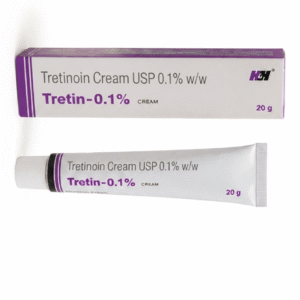
This is our tretinoin cream UK range: creams and gels in 0.025%, 0.05% and 0.1%, plus a 0.1% microsphere gel. Tretinoin is a topical retinoid used to treat acne, and…
This is our tretinoin cream UK range: creams and gels in 0.025%, 0.05% and 0.1%, plus a 0.1% microsphere gel. Tretinoin is a topical retinoid used to treat acne, and in the UK it is a prescription-only medicine.
The table below picks out one product for each strength and form; it identifies listed products and is not a recommendation. The right choice depends on your skin and your prescriber’s advice, not on the highest number. Do not use tretinoin if you are pregnant or planning a pregnancy.
Tretinoin cream and gel by strength
Each cell links to one product for that strength and form, with the pack size shown on its product page.
The percentage shows how much tretinoin each product contains. For tretinoin cream, the US prescribing information lists 0.25mg per gram at 0.025%, 0.5mg at 0.05% and 1mg at 0.1%.
From our order data (Sep 2025 to Sep 2026): 0.1% accounted for 53% of the tretinoin creams and gels we sent out, 0.05% for 28% and 0.025% for 19%. Creams outsold gels by roughly three to two.
The most-ordered strength is not automatically the right one for a particular person, as the trial below shows.
What a photoageing trial found about tretinoin strength
A higher strength is not automatically better. In a 48-week trial of 99 adults with sun-damaged facial skin, 0.025% and 0.1% tretinoin creams improved photoageing to a similar degree compared with a plain cream, and 0.1% caused significantly more redness and scaling. The trial studied photoageing rather than acne and did not include 0.05%.
Speak to your prescriber before changing strength, formulation or how often you apply it. Our tretinoin strength guide covers the evidence on each one.
Cream, gel or microsphere gel
The NHS notes that acne medicines applied to the skin usually come as a cream, gel or lotion. The US label for tretinoin adds that using too much gel makes it “pill” on the skin, which tends to stop people over-applying it.
My Tret is the microsphere option in this range: a 0.1% tretinoin gel in a microsphere formulation, in a 15g tube. Which formulation suits you is a decision for your prescriber.
Your prescriber can tell you which base suits your skin. Our cream or gel guide sets out the differences people ask about most.
Other tretinoin brands in the range
Xtralight combines two active ingredients, so it is not a like-for-like swap for a tretinoin-only cream.
Using tretinoin safely
Follow the leaflet supplied with your product and your prescriber’s directions on how much to use and how often. Keep tretinoin away from the eyes, mouth, the corners of the nose and mucous membranes, as the US prescribing information advises. Our beginner’s guide covers the first few weeks.
Side effects and sun protection
The US prescribing information notes that applying tretinoin can cause a brief feeling of warmth or slight stinging. Sensitive skin can become very red, swollen, blistered or crusted, and the prescribing information says to stop until the skin recovers or adjust use to what the skin tolerates. True allergy to tretinoin is rare. See our guide to managing tretinoin side effects.
The US prescribing information advises keeping sun and sunlamp exposure to a minimum during treatment, using sunscreen and protective clothing when exposure can’t be avoided, and not applying tretinoin to sunburnt skin. Wind and cold can also irritate treated skin.
What to expect in the first weeks
The US label notes that acne can appear to get worse during the early weeks of treatment, and that temporary lightening or darkening of the skin has been reported with repeated use. It adds that, so far, all reported side effects have cleared after stopping treatment.
A 2009 review found no clinical trial data showing that topical retinoids themselves make acne flare, and suggested that some people’s acne worsens in the first week or two as part of the condition’s natural course. Our guide to the tretinoin purge looks at this in more detail. If irritation is severe or does not settle, speak to your prescriber.
Pregnancy
The MHRA Drug Safety Update on retinoids says topical retinoids are contraindicated during pregnancy as a precaution, and that women planning a pregnancy should not use them. If you are pregnant or trying to conceive, do not use tretinoin, and speak to a GP, pharmacist or prescriber.
Tretinoin in the UK
Tretinoin is a prescription-only medicine in the UK: the NHS lists it among the acne treatments available from a GP or dermatologist with a prescription. GB rules also prohibit tretinoin as an ingredient in cosmetic products: the GB cosmetics regulation lists it among prohibited substances. Our guide to getting tretinoin in the UK explains the prescription routes, and tretinoin vs retinol compares the two.
Frequently asked questions
Is tretinoin prescription-only in the UK?
Yes. A GP, dermatologist or other prescriber decides whether it is right for you and at what strength.
Is tretinoin cream a steroid?
No. The NHS describes tretinoin as a retinoid medicine used to treat acne.
How do I get tretinoin in the UK?
Through a prescriber. The NHS says a GP may offer acne treatments you can only get with a prescription, or refer you to a dermatologist. Our UK access guide explains the routes in more detail.
Is 0.05% stronger than 0.025%?
It contains twice as much tretinoin per gram. In the 48-week photoageing trial above, 0.1% caused more redness and scaling than 0.025%; that trial did not test 0.05%, and it does not show which strength suits you.
Should I choose tretinoin cream or gel?
Both are listed in this range. Your skin and your prescriber’s advice should decide; the cream or gel guide above goes through the differences.
What is a tretinoin microsphere gel?
My Tret is listed as a 0.1% tretinoin gel in a microsphere formulation, in a 15g tube. Whether a microsphere gel, a standard gel or a cream suits you is for your prescriber to decide.
Can I use tretinoin while pregnant?
No. The MHRA says topical retinoids are contraindicated in pregnancy and should not be used when planning a pregnancy.