- Tretinoin for Beginners: A Guide to Getting Started
- Should You Choose Cream or Gel?
- Which Strength is Right for You?
- Tretinoin for Sensitive Skin: How to Use It Safely
- Tretinoin for Acne
- Tretinoin for Hyperpigmentation
- Tretinoin for Wrinkles and Fine Lines
- Tretinoin for General Skin Texture
- Tretinoin for Sun Damage


Tretinoin for Stretch Marks: What the Evidence Says About New and Old Marks


Tretinoin for stretch marks may improve early, active red marks, while evidence for old white marks is limited. In one small controlled trial, 8 of 10 participants using 0.1% tretinoin had definite or marked improvement after six months, compared with 1 of 12 using vehicle cream (Kang et al.).
Tretinoin is prescription-only in the UK. Do not use it during pregnancy or when trying to conceive. A prescriber can discuss possible benefit, irritation and other risks.
Does tretinoin for stretch marks work?
One small randomised trial found that tretinoin for stretch marks may improve early, active red marks. After six months, 8 of 10 participants using 0.1% had definite or marked improvement, compared with 1 of 12 using vehicle cream (Kang et al.). Evidence for older white marks is less clear.
Studies report different results. Some small trials found improvement, while a placebo-controlled study found no benefit from 0.025% tretinoin. Reviews describe a limited evidence base. Stretch marks may fade during the same period as treatment, so the observed change cannot be attributed to tretinoin alone.
Tretinoin may improve the appearance of early marks for some people. It has not been shown to erase stretch marks, and current studies do not give a reliable result for each mark type or person.
Tretinoin, a retinoid for stretch marks
Trials of tretinoin cream for stretch marks have reported different results, including no benefit in some studies. Trials used different strengths, mark stages and outcome measures, and several enrolled few people. Comparisons are difficult when a study had no control group or combined tretinoin with another ingredient.
Retin A for stretch marks: what do the studies show?
Retin A is a brand name for tretinoin, the medicine discussed in these studies (DailyMed label). Results vary by strength and mark stage. The clearest controlled benefit was reported for early marks.
| Study | Year | Design | Participants | Strength | Duration | Mark type | Result |
|---|---|---|---|---|---|---|---|
| Elson | 1990 | Uncontrolled study | 20 enrolled, 16 completed | Not stated in abstract | Not stated | Mixed causes | 15 of 16 completers had significant clinical improvement. PubMed |
| Kang | 1996 | Randomised, vehicle-controlled | 22: 10 tretinoin, 12 vehicle | 0.1% | 6 months | Early, active | At six months, 8 of 10 tretinoin users had definite or marked improvement, compared with 1 of 12 in the vehicle group. Mean length and width fell by 14% and 8%. PubMed |
| Pribanich | 1994 | Double-blind, placebo-controlled | 11 | 0.025% | 7 months | Pregnancy-related abdominal marks | No difference or improvement versus control. The authors concluded that 0.025% was ineffective in this study. PubMed |
| Rangel | 2001 | Open-label, multicentre prospective | 20 | 0.1% | 3 months | Pregnancy-related abdominal marks; stage not stated | The target lesion length fell by 20% at week 12. Erythema and scaling occurred in 11 participants. PubMed |
| Ash | 1998 | Comparative topical study | 10 | 0.05%, used with glycolic acid | 12 weeks | White marks | Both treatment regimens improved appearance. The design cannot isolate tretinoin’s effect from glycolic acid and the other ingredients. PubMed |
| Hexsel | 2014 | Randomised pilot comparison | 32 women | 0.05% | Daily treatment; study duration not stated in abstract | Early red marks | Tretinoin and dermabrasion both improved marks from baseline; the study found no significant difference between them. PubMed |
| Karia | 2016 | Comparative prospective study | 50 total; 10 in tretinoin group | 0.1% gel | 1 year of assessments; treatment schedule varied | Red marks | Tretinoin had the least response among the five groups; 8 of 10 had minimal improvement. PubMed |
A 2016 review found few studies of topical treatments and varied results for tretinoin. Most studies did not separate early marks from later ones (topical-treatment review).
The 0.1% result for early marks comes from one controlled trial. A 2026 systematic review also found small, low-quality studies and did not identify one treatment suited to every case (systematic review).
New red marks and old white marks
Evidence for tretinoin is clearer for early red marks than for older pale marks, though studies do not always separate the stages. Stretch marks, or striae distensae, can begin as red, pink or purple lines and later fade to pale or silvery marks. Clinicians call newer red marks striae rubra and older pale marks striae alba.
Does tretinoin work on old stretch marks?
Evidence for old white stretch marks is especially limited. A placebo-controlled study found no benefit from 0.025% tretinoin. Many topical studies did not clearly separate early marks from later ones. An older study combined tretinoin with glycolic acid, so its results cannot show which ingredient accounted for any change.
Results for red marks also differ. A 2020 network meta-analysis ranked topical tretinoin lowest for clinical effectiveness and patient satisfaction among the treatments it compared. Its authors called for larger trials (Lu et al., 2020).
Red colour or recent onset does not guarantee a response. Older marks may remain visible after treatment. Stretch marks involve changes in dermal collagen, but the reason for improvement in the Kang trial remains unclear. Biopsy measures of collagen and elastic fibres did not differ significantly between groups (Kang et al.).
Which strength and how long?
The strongest controlled result came from 0.1% tretinoin used on early marks for six months. Other studies tested 0.1% for three months or 0.05% on early marks, with different designs and results. A controlled study of a lower strength found no improvement after seven months. No study shows that one strength works for everyone.
The main trial recorded improvement by two months and assessed participants at six months. An open-label study reported a shorter target lesion at week 12. These were research schedules, not instructions for personal use. Ask a prescriber how often to apply tretinoin. Do not increase the amount or strength to speed up a result.
From our order data (Sep 2025 to Sep 2026): 53% of tretinoin units sold were 0.1%, the strength used in the early-mark trial with a positive result. These data cover one store and UK customers. Units are not people. December 2025 has no orders, which may reflect a store closure or a data gap.
Our guide to tretinoin concentration and strength covers available strengths. A prescriber must decide whether tretinoin is suitable and how to use it on the area being treated. Face directions, such as a pea-sized amount for the whole face, do not set an amount for a larger body area. Ask your prescriber what quantity to use.
How to use tretinoin on stretch marks
Tretinoin is a prescription-only medicine in the UK. Use it only if it was prescribed for you. The NHS guidance on topical retinoids covers acne. The Treclin patient leaflet applies to one tretinoin-containing gel prescribed for acne. It advises avoiding the eyes, mucous membranes, damaged skin and sunlight.
Those directions are specific to acne and that product. Follow your own leaflet and prescriber’s instructions for stretch marks. The 0.1% trial applied tretinoin daily, but that schedule is not a personal dosing recommendation.
If a prescriber has recommended topical use, these general steps can help reduce avoidable irritation:
- Ask where and how often to apply it, especially if the marks are on breasts, inner arms or another sensitive area.
- Apply it only as directed for your product. Do not use it on broken skin or near the eyes, lips or other mucous membranes unless your prescriber says to.
- Use only the amount prescribed. Do not apply it more often to speed up a result.
- Ask your prescriber how to manage dryness and protect exposed skin from sunlight.
Skin on the breasts and inner arms can be more sensitive. Redness, dryness, peeling or stinging may occur. Stop applying tretinoin and contact a GP, pharmacist or dermatologist if you have:
- severe or persistent redness, burning or pain
- blistering, broken skin, swelling or a painful rash
- irritation that does not settle after stopping
- signs of infection or a serious allergic reaction, which need prompt medical help
Pregnancy, breastfeeding and stretch marks
Do not use tretinoin during pregnancy or when trying to conceive. If you become pregnant while using it, stop and contact your prescriber or GP. Ask a GP, pharmacist or dermatologist before using it while breastfeeding, especially if you would apply it near the breast.
Two older PubMed records have no abstracts, so their methods and findings cannot be assessed: Shapiro et al. and Martínez-Frías et al.. A 2026 review pooled eight studies covering 3,632,118 pregnancies and found no statistically significant association between topical retinoid exposure and major congenital malformations or spontaneous abortion (Alali et al.). Its authors said the findings were driven mainly by one large registry study.
UK guidance remains clear: avoid tretinoin during pregnancy or when trying to conceive. A prescriber can advise on use while breastfeeding. Evidence for preventing and treating pregnancy-related stretch marks remains limited. Korgavkar and colleagues’ review found few reliable topical prevention methods and noted that pregnancy safety concerns limit tretinoin use.
UK searches for tretinoin for stretch marks increased year on year
Our analysis of UK Google search data recorded 6,020 searches for the measured keyword from September 2025 to August 2026, compared with 4,840 in the previous 12 months. That is a 24% year-on-year increase. The highest monthly bucket in the latest year was 720 in February 2026. Google groups close variants and rounds volumes into buckets, so these figures indicate search demand rather than a count of people.
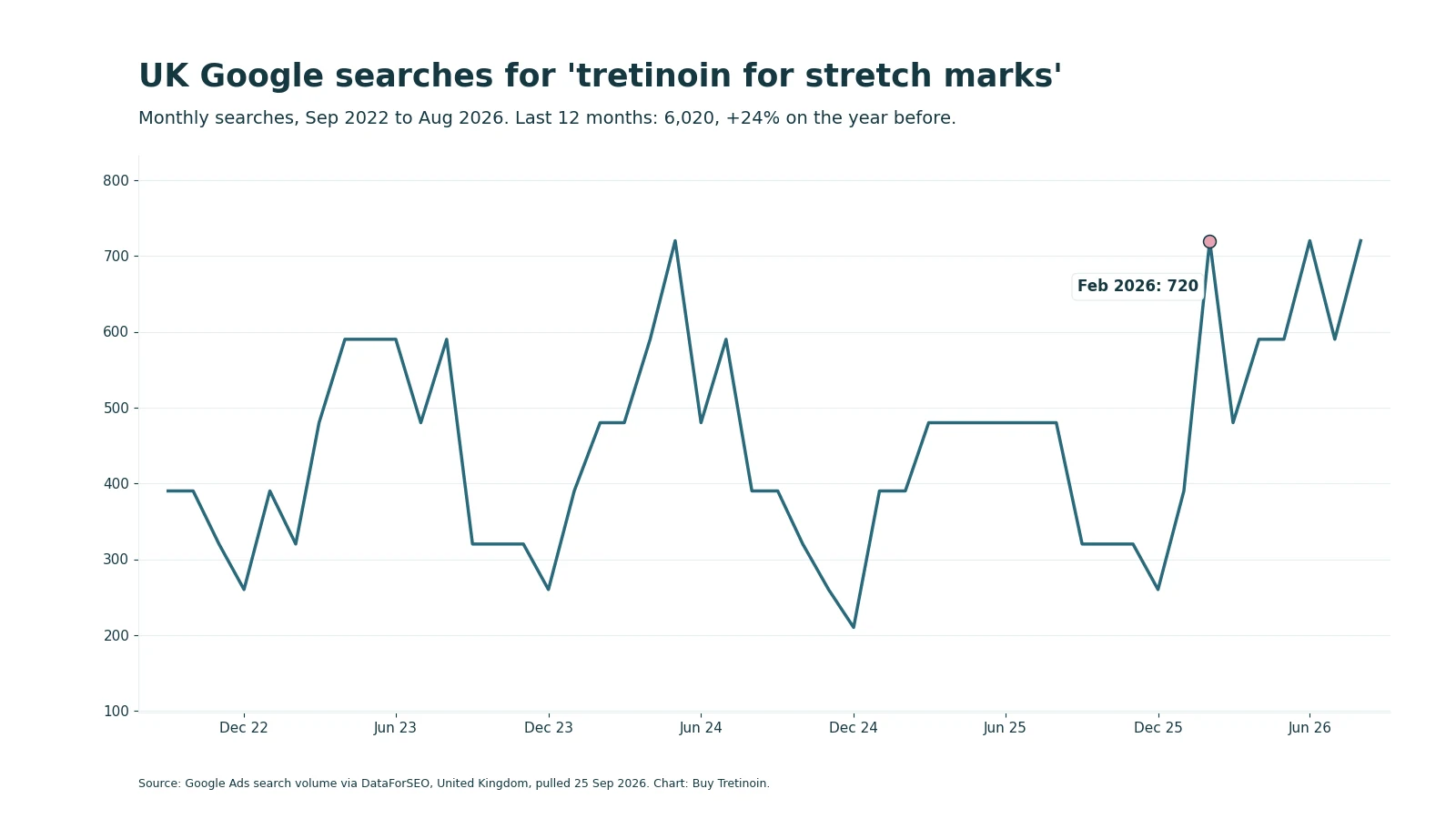
Search volumes varied by month, with a higher total in the latest year than the year before. The data do not explain why people searched or predict future demand, and the chart does not show visits to this article.
Other options with evidence
A dermatologist can assess your marks and explain procedural options and their risks. A 2020 network meta-analysis ranked bipolar radiofrequency, including with topical tretinoin, highly. Among laser options, it ranked fractional CO2 laser highest. These rankings compare treatments across the included studies; they do not predict an individual’s result. See our guide to tretinoin for acne scars for a separate discussion of retinoids and scars.
For topical products, one review found limited evidence that centella may help prevent pregnancy-related marks and weak evidence for hyaluronic acid. Another review found no topical formulation established as the most effective for stretch marks (Ud-Din et al.). Moisturisers can help with skin comfort, but the reviewed sources do not show that a cosmetic cream removes existing marks.
- For early marks, a prescriber may discuss tretinoin where it is suitable and pregnancy is not a concern.
- For established pale marks, ask a dermatologist whether a procedure is appropriate and what risks it carries for your skin.
- During pregnancy, do not use tretinoin. Ask a maternity care professional about any product or treatment you are considering.
Prescribing and follow-up
Follow your prescriber’s directions if tretinoin has been prescribed for you. Arrange a review if the area becomes very irritated or you are unsure whether it is helping. For product information, see our tretinoin range. A store listing cannot determine whether a prescription medicine is suitable for you.
For related reading, see our guides to tretinoin before and after, the tretinoin purge and tretinoin under the eyes. These cover different questions and should not replace advice from your prescriber.
Frequently asked questions
Does tretinoin get rid of old stretch marks?
Evidence for tretinoin for stretch marks is limited when marks are old and white, a stage called striae alba. A small study found no improvement with 0.025% tretinoin, while the clearest controlled benefit was in early, active marks. Older marks may change in appearance over time, but tretinoin cannot be expected to remove them. A prescriber can discuss whether another treatment is suitable.
How long does tretinoin take to work on stretch marks?
The main controlled trial found improvement in early marks by two months, with outcomes assessed after six months. That result came from a small study using 0.1% tretinoin. It does not establish a timeline for every person or for older white marks. Follow your prescriber’s instructions and review irritation or lack of progress with them.
Can I use tretinoin on stretch marks while breastfeeding?
Ask your GP, pharmacist or dermatologist before using tretinoin while breastfeeding. Tretinoin is a prescription-only medicine in the UK, and a prescriber should assess your circumstances and where you would apply it. Do not start leftover or someone else’s medicine.
Is retinol or tretinoin better for stretch marks?
The trial evidence in this guide concerns tretinoin, with mixed results and the clearest controlled benefit for early marks. It does not establish that tretinoin is better than retinol, because the studies did not make a direct comparison. Ask a clinician or pharmacist which option is appropriate for you, especially if you are pregnant, breastfeeding or planning pregnancy.
Can tretinoin prevent stretch marks?
Evidence that creams prevent stretch marks is limited. A review of topical prevention during pregnancy found weak evidence for hyaluronic acid and limited evidence for centella, while noting that reliable prevention methods are scarce. Tretinoin should not be used during pregnancy. Speak with a GP, pharmacist or dermatologist before using any prescription treatment to prevent marks.
What can I learn from tretinoin stretch marks before and after photos?
Before-and-after photos show how one person’s marks looked at two points in time. They cannot show whether tretinoin caused the change or predict another person’s result. For tretinoin for stretch marks, controlled trials offer a fairer comparison between groups. Our guide to tretinoin before and after explains how to read those images with care.
How we wrote this
We reviewed the linked PubMed abstracts, including trials and reviews of stretch mark treatments and pregnancy safety. We analysed UK Google search data from September 2022 to August 2026 and order data from September 2025 to September 2026. These sources cannot set an individual care plan. This post is general information, not medical advice. Last reviewed 25 September 2026. Corrections: support@buytretinoin.org.