- Tretinoin for Beginners: A Guide to Getting Started
- Should You Choose Cream or Gel?
- Which Strength is Right for You?
- Tretinoin for Sensitive Skin: How to Use It Safely
- Tretinoin for Acne
- Tretinoin for Hyperpigmentation
- Tretinoin for Wrinkles and Fine Lines
- Tretinoin for General Skin Texture
- Tretinoin for Sun Damage


Tretinoin for Acne Scars: Does It Really Work?

Tretinoin for Acne Scars: Does It Really Work?
Acne scarring is one of the most common reasons people search for tretinoin in the first place — and one of the most misunderstood. Tretinoin can meaningfully improve the appearance of certain types of acne scars, but it doesn’t work the same way on every scar type, and expectations matter as much as the product itself. Here’s an honest look at what tretinoin can and can’t do for scarring, and how to get the most out of it.
What Tretinoin Actually Does to Skin
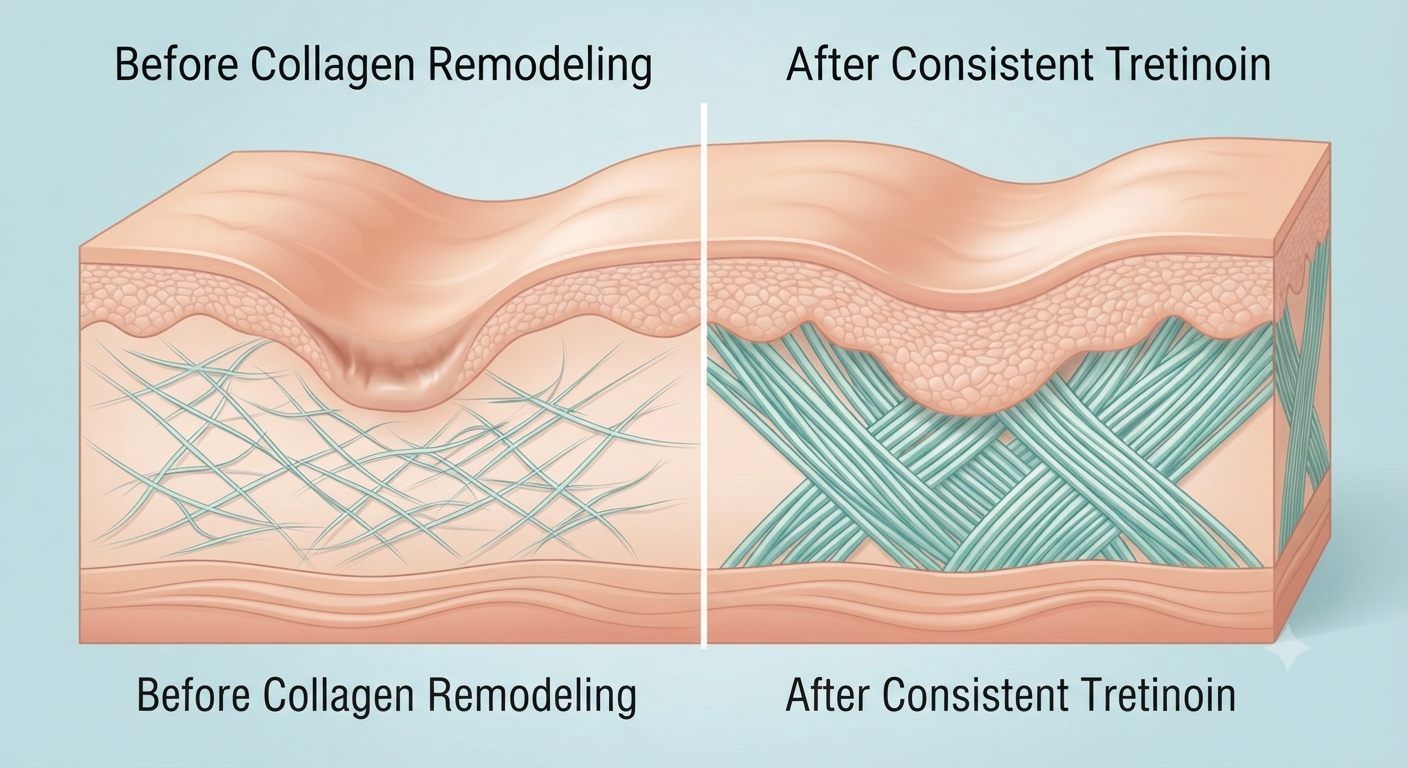
Tretinoin works by speeding up cell turnover and stimulating collagen production in the deeper layers of skin. This is the mechanism behind its effectiveness for fine lines and, importantly, for certain types of textural scarring — collagen remodeling is exactly what smooths out shallow depressions in the skin over time.
Which Types of Acne Scars Tretinoin Can Help
Shallow rolling and boxcar scars. These are caused by damaged collagen just beneath the skin’s surface. Because tretinoin promotes collagen production and turnover, consistent long-term use can noticeably soften these types of scars, making them less visible even if they don’t disappear entirely.
Post-inflammatory hyperpigmentation (PIH). Often mistaken for “scarring,” these are the dark or red marks left behind after a pimple heals. Because tretinoin speeds up cell turnover, it can help fade PIH faster than skin would clear on its own — this is actually one of the areas where tretinoin performs most reliably.
Uneven texture from years of breakouts. Beyond individual scars, cumulative texture irregularity often responds well to tretinoin’s exfoliating and collagen-boosting effects over several months of consistent use.
Which Types of Scars Tretinoin Cannot Fix
Deep ice pick scars. These narrow, deep scars extend far below the surface and generally require in-office procedures like subcision, TCA CROSS treatment, or laser resurfacing. Tretinoin alone will not resolve scars at this depth.
Deep, established boxcar scars. While tretinoin can soften the edges and improve overall texture, more significant depressions typically need a combination approach involving professional treatments.
Keloid or hypertrophic (raised) scars. These respond to entirely different treatment approaches, such as steroid injections or silicone sheeting, and tretinoin is not an effective treatment for this scar type.
It’s worth being clear-eyed about this distinction before starting treatment — tretinoin is genuinely effective for texture and pigmentation, but it isn’t a substitute for procedures when scarring is deep or raised.
How Long Results Actually Take
This is where patience matters most. Improvement in post-inflammatory marks can sometimes be visible within 6–8 weeks, but true textural and scar-related changes require sustained collagen remodeling, which typically takes 3–6 months of consistent use to become noticeable, and up to a year for more significant improvement. For a broader breakdown of the treatment timeline, see our guide on how long tretinoin takes to work.
Getting Started: Strength and Consistency
Because scarring improvement depends on long-term collagen turnover rather than a quick surface effect, consistency matters more here than with almost any other use case for tretinoin. Many people find it easier to stay consistent by starting at a lower strength and building up gradually, rather than starting strong and stopping due to irritation. Our guide on tretinoin concentration and which strength is right for you can help you choose a starting point, and our article on building a complete tretinoin routine covers exactly how to apply it correctly, morning and night.
What to Combine It With for Better Scar Results
- Daily SPF 50 — critical for allowing post-inflammatory marks to fade rather than darken further from UV exposure; we recommend our own Z-Block SPF 50.
- A ceramide-based, barrier-repair moisturizer — our own Lipidz Barrier Cream — to support the skin barrier while collagen remodeling takes place underneath.
- Patience over product-switching — jumping between actives before giving tretinoin enough time (typically 3+ months) is one of the most common reasons people conclude “it didn’t work” when it simply hadn’t had time to.
- Professional treatments for deeper scars, used alongside tretinoin rather than instead of it, for a more complete result on more significant scarring.
Setting Realistic Expectations
Tretinoin is genuinely one of the more evidence-supported over-the-counter and prescription options for improving acne scar texture and post-acne marks, particularly compared to most skincare actives marketed for the same purpose. But it works gradually, through the same collagen-building mechanism responsible for its anti-aging effects — not through fast surface exfoliation. Going in with a realistic timeline (months, not weeks) is the single biggest factor in whether people stick with it long enough to see results.
Tretinoin can meaningfully improve shallow scarring, uneven texture, and especially post-inflammatory marks left behind by acne — but it isn’t a fix for deep or raised scarring, and it requires consistent use over several months to show its full effect. Paired with daily Z-Block SPF 50 and a supportive Lipidz Barrier Cream, it remains one of the most reliable long-term options for improving acne-scarred skin. Explore our full range of tretinoin strengths to find the right starting point for your skin.