Tretinoin Routine: Morning and Night Steps
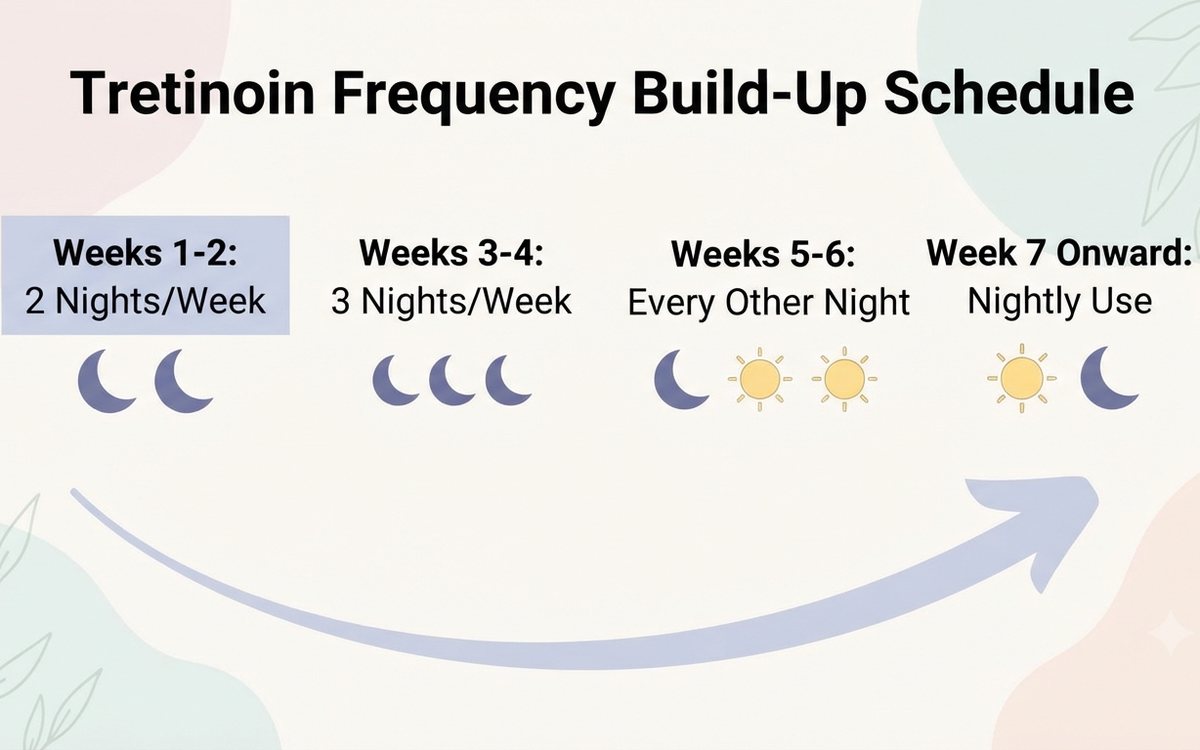
A tretinoin routine usually pairs a simple morning cleanse, moisturiser and sun protection with evening tretinoin only as directed on your prescription and product leaflet; the same directions set how often to apply it, whether to buffer with moisturiser, and which other medicines can share your routine.
The eMC lists Treclin, a clindamycin and tretinoin gel, as a prescription-only medicine and gives product-specific directions in its Summary of Product Characteristics. Those directions apply to Treclin. The Treclin patient leaflet is also product-specific, so check the leaflet supplied with your own medicine.
Before starting a tretinoin routine
A tretinoin routine should follow your own prescription and product leaflet, because online advice cannot identify the medicine, strength or treatment plan you have been given. Check the product name and directions before applying it. If anything is unclear, ask the prescriber or pharmacist. Do not use someone else’s medicine or increase an application because you missed one.
The eMC classifies Treclin, which contains clindamycin and tretinoin, as prescription-only and specifies its own use for acne. That record does not set instructions for every tretinoin product. Regulation 284 of the Human Medicines Regulations 2012 restricts public advertisements likely to lead to use of a prescription-only medicine; it concerns advertising and does not establish the status of an unverified product. You can read more about starting tretinoin and what to discuss with the person prescribing it.
Do not use topical tretinoin during pregnancy or when trying to conceive. The MHRA says topical retinoids are contraindicated during pregnancy as a precaution, and the Treclin SmPC contraindicates that product in pregnancy and for women planning pregnancy. Ask your prescriber about your own medicine and pregnancy plans.
Morning steps with tretinoin
In the morning, cleanse gently or rinse, use moisturiser if your skin needs it, and follow the sun protection label. The Treclin SmPC warns that photosensitivity may occur during treatment with that gel and advises minimising sun exposure and using sunscreen of at least SPF 30. Sun protection limits UV exposure; it does not prevent every irritation reaction.
You can keep the morning routine short while you learn how your skin responds. If you already use a prescribed morning treatment, ask a pharmacist or prescriber how it fits with your tretinoin plan. Vitamin C is optional; you can leave it out of your tretinoin routine. Its use and timing are discussed below because the evidence does not establish one universal schedule.
Evening order: how to use tretinoin cream
The evening order is to cleanse gently, let the skin dry, then apply tretinoin exactly as the label directs and use moisturiser if it fits your plan. The eMC says Treclin is applied at bedtime, but that is the instruction for this specific combination product. Follow the instructions for your own prescription.
A fixed waiting time is not universal in the sources reviewed; let your skin dry and follow the product directions. If the leaflet does not specify whether morning use is appropriate, ask your prescriber or pharmacist.
Do not apply extra medicine to make up for a missed application. Avoid adding several new products at the same time, since irritation then becomes harder to trace. Keep the medicine in its original packaging and follow its storage directions. If you are unsure about missed doses, application areas or other medicines, check with your pharmacist.
Morning and evening steps at a glance
Use this as an order guide. Your leaflet and prescriber set how often to use tretinoin.
| Time | Basic order | Keep in mind |
|---|---|---|
| Morning | Gentle cleanse or rinse, moisturiser if needed, sun protection | Add optional products only if they suit your plan and skin |
| Evening with tretinoin | Cleanse, allow skin to dry, prescribed medicine, moisturiser if advised | Use the prescribed amount and frequency |
| Evening without tretinoin | Gentle cleanse and moisturiser | Avoid adding an exfoliant or another retinoid without advice |
For sun protection, follow the sunscreen label and use shade, clothing or a hat when helpful. Sun protection addresses UV exposure, while irritation can have other causes.
Tretinoin and moisturiser: before or after?
Moisturiser may go before or after tretinoin when that order is part of your advice, but it should not change the prescribed amount or frequency. Applying moisturiser first is sometimes called buffering. Using moisturiser around the medicine is sometimes called a sandwich method. These are application approaches, not separate tretinoin doses.
NICE advises measures such as a mild, non-alkaline cleanser and non-comedogenic moisturiser if irritation occurs with topical acne treatment. It also advises considering alternate-day or short-contact application when starting or restarting topical treatments to reduce irritation risk. Follow the plan agreed for your own medicine rather than changing its instructions independently.
Choose a moisturiser that you tolerate and avoid adding several new formulas at once. Our guide to choosing a moisturiser for tretinoin covers the practical selection questions. Do not mix tretinoin into moisturiser unless the product information or your prescriber specifically tells you to.
Tretinoin and vitamin C: can they be used together?
Vitamin C and tretinoin can sit in the same skincare plan, although the evidence does not set a universal order or establish compatibility for every formulation. Retin-A is a US brand name for tretinoin, so searches for “Retin-A and vitamin C serum” ask the same timing question.
A practical option is vitamin C in the morning and tretinoin in the evening. This separates the products and keeps the routine straightforward. The sources do not set this as a universal timing rule, so use your medicine’s directions and ask your prescriber or pharmacist about specific products.
A review of topical rejuvenation describes photoprotection and topical retinoids as core parts of an anti-ageing regimen, with vitamin C added for specific concerns. It also notes stability and absorption as considerations (Berry et al., 2023).
L-ascorbic acid, vitamin C derivatives and timing
L-ascorbic acid is vitamin C, and topical products may also use chemically modified derivatives. A review explains that these derivatives were developed in attempts to improve stability, skin absorption and activity in topical formulations (Enescu et al., 2022). That review does not identify a universally preferred form or establish that vitamin C has to be used with tretinoin.
The morning and evening split is a practical way to keep products separate and easier to track. It is not a rule set by these sources. They do not establish a universal pH conflict, order of application or requirement to separate the ingredients. Avoid mixing a vitamin C serum directly into your medicine, and follow the medicine’s own directions.
Vitamin C serum or moisturiser?
The evidence here does not compare vitamin C serum with vitamin C moisturiser alongside tretinoin, so it cannot show that one format is superior. A small comparative study analysed 14 patients with photodamaged skin over 10 weeks. It compared 0.05% tretinoin emollient cream alone or with ascorbic acid lotion, with or without six superficial TCA peels. Every group improved, and the combined topical regimen with peels improved skin topography most (Rachel and Jamora, 2003).
The study was small and old, involved peels, and did not study acne or unsupervised product layering.
If you want to try a vitamin C product, keep it separate from the prescription medicine and add only one optional product at a time. The review by Berry and colleagues notes that a simple topical regimen can reduce irritation and support adherence (Berry et al., 2023). If the vitamin C product stings, pause that optional product and simplify your routine. Ask a pharmacist or prescriber for advice if stinging persists or you are unsure whether another treatment is involved.
- Check the product label and your prescription directions.
- Add one optional product at a time so a reaction is easier to trace.
- Pause the optional product if it stings, and seek advice if discomfort continues.
How to time other ingredients
Ingredient timing depends on the exact product, the reason it was prescribed and how your skin responds. NICE notes that topical retinoids and benzoyl peroxide can irritate skin, and a systematic review describes trials of topical retinoids alone and in combinations. Neither source supports adding every active to every tretinoin routine.
| Ingredient | Practical approach | What the evidence supports |
|---|---|---|
| Vitamin C | Optional; consider separate morning use if that suits your plan | Formulations vary; no universal timing or incompatibility was established |
| Niacinamide | Check the whole formula and introduce one change at a time | No source here establishes a required pairing or universal order |
| AHA or BHA acids | Ask before adding an exfoliating acid if irritation is present | Ask a prescriber or pharmacist if it is part of a prescribed plan |
| Benzoyl peroxide | Use a prescribed combination only as directed | NICE discusses irritation; trials do not mean every person should add it |
| Azelaic acid | Check with the prescriber or pharmacist if it is another active treatment | See the separate guide to azelaic acid and tretinoin |
| Retinol | Do not treat cosmetic retinol as interchangeable with tretinoin | Read about tretinoin versus retinol before combining retinoids |
NICE NG198 advises ways to reduce irritation from topical acne treatments, including retinoids and benzoyl peroxide; it does not recommend every ingredient combination for every person (NICE recommendations). A UK clinical update on acne treatment summarises this guidance and stresses adherence, while noting that treatment choices depend on the clinical plan (full text in PubMed Central).
If niacinamide is part of your routine, see our page on niacinamide with tretinoin. A pharmacist can check a product list with you, including non-prescription cosmetics and prescribed treatments.
Adjusting the routine during the first weeks
During the first weeks, keep the schedule tied to your prescriber’s directions and note any persistent irritation or changes. Do not escalate use because your skin has not changed quickly. NICE says to allow 6 to 8 weeks for acne treatments to work and gives irritation-reduction advice for topical treatments; this is general acne guidance, not a promise about your product (NICE NG198 recommendations).
A UK clinical update on acne treatment summarises NICE advice about irritation and adherence; it is not a product-specific tretinoin schedule (full text in PubMed Central).
Add optional skincare one item at a time so you can identify what is causing a reaction. If irritation appears, ask the prescriber or pharmacist whether the plan needs adjusting. For more detail on tretinoin side effects, see our separate guide. A flare in acne should not be dismissed automatically as a “purge”; the term does not identify the cause.
When to stop and speak to a clinician
Stop using the medicine and contact your GP, pharmacist or dermatologist if you develop severe or persistent symptoms such as:
- A marked or worsening rash.
- Painful redness or pronounced peeling.
- Dryness or irritation that persists despite following your plan.
- Sunburn or another reaction that concerns you.
For the Treclin combination product, the SmPC lists dryness, erythema, rash, exfoliation and sunburn. Frequencies may differ across tretinoin formulations.
Seek advice if the medicine gets into your eyes or mouth or the treated area becomes very sore. Do not try to manage a severe reaction by adding acids or another active. If acne worsens or you are concerned about a flare, our tretinoin purge guide explains why irritation and acne changes need to be considered separately.
A routine guide cannot check your diagnosis, medicine or product leaflet. If the instructions on your prescription and general skincare advice differ, use the prescription directions and contact your prescriber or pharmacist for clarification.
Frequently asked questions
What is a good routine for tretinoin?
Use a gentle cleanser, apply prescribed tretinoin at the time and frequency on your own label, add moisturiser if suitable, and use sun protection during the day. Keep other actives limited until you know how your skin responds. The exact product instructions and prescriber’s plan take priority over a routine copied from a website.
Should tretinoin be used every night?
Use tretinoin only as often as your prescriber and product leaflet direct. Different products and treatment plans can have different instructions. NICE gives guidance on reducing irritation when topical acne treatments are started or restarted, but that does not replace the directions for your medicine. Ask your prescriber or pharmacist before changing frequency.
Do I need to use vitamin C with tretinoin?
No vitamin C step is required by the evidence reviewed for this guide. Vitamin C products vary in form and formulation, and no source here establishes a universal need to use one with tretinoin. If you choose to use both, introduce the cosmetic product separately and ask a pharmacist or prescriber if you are also using other medicines.
Can I use Retin-A and vitamin C together?
Retin-A is a US brand name for tretinoin, so the question is about using tretinoin with vitamin C. The sources reviewed do not establish that every formulation is incompatible or that every combination is comfortable. Separate morning and evening use is one practical option if your prescription allows it. Do not mix the products together, and simplify if irritation develops.
Do I apply tretinoin before or after moisturiser?
Follow your own product leaflet and prescriber’s instructions. Some people are advised to apply moisturiser before tretinoin as a buffer, while others use it afterwards. The order can be part of an individual tolerability plan. Do not mix tretinoin into moisturiser or change the prescribed amount to copy an online routine.
What cancels out tretinoin?
There is no general ingredient rule in the evidence reviewed that says vitamin C, niacinamide or another skincare ingredient automatically cancels tretinoin. Formulation, prescribed medicines and irritation matter. Avoid changing a prescribed combination based on a broad internet rule, and ask a pharmacist or prescriber to check the specific products you use.
Do I need to wait a set time before applying tretinoin?
There is no fixed waiting period established by the sources reviewed here. Follow the leaflet supplied with your medicine and any directions from your prescriber. Letting skin dry before application is included in this guide as a practical step, while the exact timing depends on the product instructions and your treatment plan.
How we wrote this
We read NHS acne information, the MHRA Drug Safety Update on retinoids and the NICE NG198 guideline overview, and checked Treclin’s SmPC and patient leaflet as separate product documents. We compared Treclin’s bedtime instruction with NICE’s general irritation guidance and a UK acne treatment update in PubMed Central. These sources do not identify the right schedule, formulation or combination for an individual, or set a universal vitamin C routine.
This is general information, not medical advice. Last reviewed 19 October 2026. Corrections: support@buytretinoin.org