- Tretinoin for Beginners: A Guide to Getting Started
- Should You Choose Cream or Gel?
- Which Strength is Right for You?
- Tretinoin for Sensitive Skin: How to Use It Safely
- Tretinoin for Acne
- Tretinoin for Hyperpigmentation
- Tretinoin for Wrinkles and Fine Lines
- Tretinoin for General Skin Texture
- Tretinoin for Sun Damage


Azelaic Acid and Tretinoin: How to Use Them Together Safely

Azelaic Acid and Tretinoin: How to Use Them Together Safely
A prescriber may recommend azelaic acid with tretinoin in the same treatment plan. Many routines place azelaic acid in the morning and tretinoin at night.
Azelaic acid and tretinoin may address different concerns, such as acne and marks left after spots. Either can irritate skin, so follow your prescription and introduce changes gradually. Ask your prescriber how to space the medicines and when to review the routine.
Can you use tretinoin and azelaic acid together?
Yes. A prescriber may recommend azelaic acid and tretinoin together at separate times of day. Azelaic acid is used for acne, rosacea and pigmentation concerns. Tretinoin is a topical retinoid prescribed for acne and other skin conditions. Both can irritate the skin, so ask your prescriber how to introduce them.
In the UK, tretinoin is prescription-only, as is azelaic acid at 15% to 20%. The MHRA medicines information database publishes UK product leaflets and summaries of product characteristics. Use medicines supplied on a valid prescription and follow the prescriber’s instructions. Ask a GP, pharmacist or dermatologist before applying either to broken or inflamed skin.
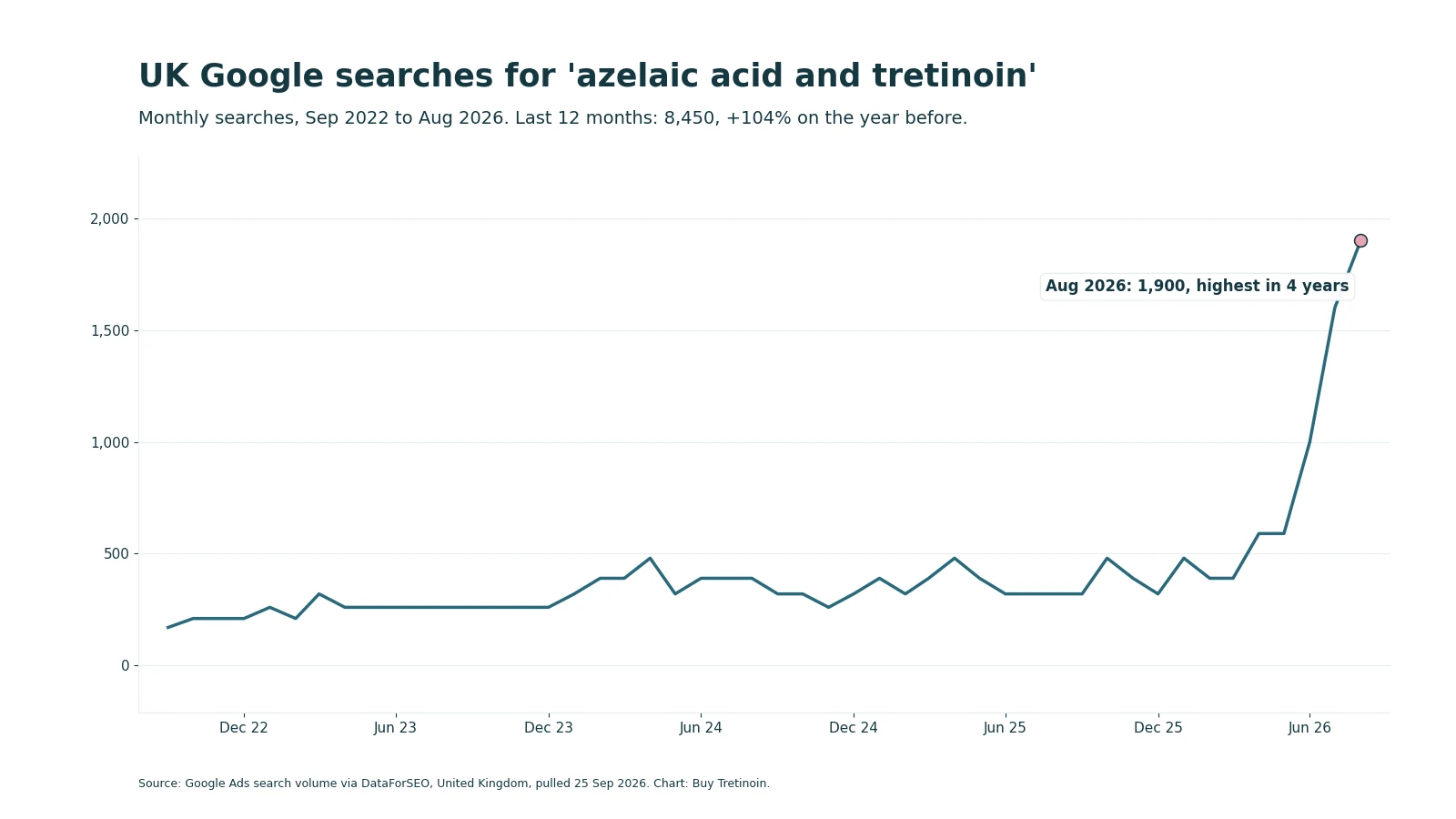
Why searches for this pairing doubled in a year
Our analysis of UK Google search data counted 8,450 searches for “azelaic acid and tretinoin” in the 12 months to August 2026. The previous 12 months recorded 4,150. That is a rise of 104%, calculated as (8,450 minus 4,150) divided by 4,150. August 2026 reached 1,900 searches, the highest month in the 48-month series.
These rounded estimates come from UK Google search data, which groups close variants and cannot show why people searched or whether they started treatment.
What each ingredient does
Azelaic acid and tretinoin both have a place in acne care, while azelaic acid is also used for rosacea and pigmentation. Tretinoin is a topical retinoid recommended in acne guidance. The comparison studies below focus on acne or melasma, so they do not answer every question about these uses.
| Ingredient | Main targets | How it is used | UK status and studied strengths | Irritation and pregnancy |
|---|---|---|---|---|
| Azelaic acid | Acne lesions, post-acne marks, rosacea and melasma | Has antikeratinising, antibacterial and anti-inflammatory effects described in clinical literature | 15% to 20% products are POMs; studies include 15% gel and 20% cream | Burning or stinging can occur, as reported in rosacea studies. Source Ask a prescriber about use in pregnancy. |
| Tretinoin | Comedonal acne and some prescribed pigment plans | A topical retinoid used for acne | POM; a head-to-head acne study used 0.05% cream | Local irritation and scaling are reported with topical treatments. Source Do not use in pregnancy or when trying to conceive. |
For fine lines, a review found no eligible trials of azelaic acid for skin ageing. King et al., 2023 Before adding a second medicine, ask what it is intended to treat and how your prescriber will judge whether it is helping.
What the evidence says about azelaic acid vs tretinoin
Most studies assess azelaic acid or tretinoin separately, and their results do not establish how a routine using both will work. Acne findings do not automatically apply to melasma, rosacea or every formulation.
- In a study of comedonal acne, 20% azelaic acid cream and 0.05% tretinoin cream had similar effects on comedones and overall response. Azelaic acid caused fewer local side effects in that study. Katsambas et al., 1989
- A 1996 overview described 20% azelaic acid as having acne efficacy comparable with 0.05% tretinoin in mild to moderate acne. It was a review of European trials, not a modern trial of today’s paired routine. Graupe et al., 1996
- A review of melasma studies reported more skin lightening after three months when azelaic acid was combined with tretinoin than with azelaic acid alone. This is older evidence and does not establish a routine or result for every patient. Breathnach et al., 1996
- In a network meta-analysis of 59 randomised trials, azelaic acid ranked above tretinoin in the relative-efficacy ranking against placebo. This was an indirect comparison across treatments, not a trial of the two together; the authors said more trials were needed. Liu et al., 2021
- The American Academy of Dermatology guideline gives strong recommendations to topical retinoids for acne and a conditional recommendation to azelaic acid. It recommends combining topical treatments with different mechanisms as good practice, which is broader than evidence for this specific pair. Reynolds et al., 2024
A Cochrane review found probably little or no difference between azelaic acid and tretinoin in acne treatment response, based on one study. It also noted uncertainty around minor adverse events in that comparison. Liu et al., 2020
A week-by-week plan for introducing both medicines
This week-by-week schedule is a discussion guide for people prescribed both medicines. Keep to each medicine’s directions. If you already use one, ask your prescriber before changing its schedule to fit the table. Introduce only the second medicine they recommend, at the time they advise.
- Keep your existing routine stable before adding a second active.
- Ask the prescriber whether the second medicine belongs in your plan and when to start it.
- Use separate morning and evening routines if advised. Change one thing at a time and pause for advice if irritation persists.
| Period | Morning | Evening | What to check |
|---|---|---|---|
| Weeks 1 to 2 | Keep your current routine. If prescribed azelaic acid, use it as directed. | Keep your current routine. If prescribed tretinoin, use it as directed on clean, dry skin. | Note dryness, persistent sting or redness before adding anything. |
| Weeks 3 to 4 | Add the second medicine only if your prescriber agrees and the first is comfortable. | Keep tretinoin in the evening if that is your instructed schedule. | Avoid adding exfoliants or other new actives at the same time. |
| Weeks 5 to 8 | Continue the agreed morning routine and sunscreen. | Continue the agreed evening routine. | Ask the prescriber for a review if irritation continues or acne worsens. |
| Week 8 onwards | Keep the routine that is prescribed and tolerated. | Do not increase frequency or strength without advice. | Review whether each ingredient still has a clear role. |
For evening tretinoin, cleanse gently and let your face dry. Apply the prescribed pea-sized amount across the face, avoiding the eyelids, nose creases and lips unless your prescriber says otherwise. Follow with moisturiser. In the morning, use azelaic acid as directed, then moisturiser and sunscreen. Check each leaflet for product-specific instructions.
When a prescriber may consider both medicines
When someone has more than one diagnosed concern, a prescriber may discuss both medicines for:
- Acne with post-inflammatory hyperpigmentation, where treating active spots and lingering marks are both concerns.
- Melasma, where treatment choice needs assessment and sun protection is part of care. Read about tretinoin and hydroquinone for context on another prescribed pigmentation combination.
- Rosacea-prone skin when acne is also being treated. Azelaic acid has evidence for rosacea, but tretinoin may irritate sensitive skin. Ask whether it is suitable, or read our guide to azelaic acid for rosacea.
The evidence does not establish that everyone with redness, marks or acne needs both. If one medicine addresses your concern, the other may have no clear role. Ask a clinician to assess a mark if you are unsure whether it is melasma or post-acne pigmentation.
What not to mix, and signs to scale back
Avoid using benzoyl peroxide in the same routine as tretinoin unless your prescriber advises it. Ask before adding AHAs or BHAs, and leave vitamin C out while your skin is sensitised. A pharmacist can check the full ingredient list if you use several treatments.
Stop applying the medicines and speak to a GP, pharmacist or dermatologist if you notice:
- Burning or stinging that persists, or worsening redness.
- Cracking, raw patches, marked swelling or painful skin.
- Eye symptoms, suspected infection or a rash spreading beyond the treated area.
- A severe flare or irritation that continues after you stop the products.
If acne seems worse after starting tretinoin, read our guide to the tretinoin purge. If you are considering another active, see how niacinamide fits with tretinoin. For a reaction or a change to your medicines, contact your GP, pharmacist or prescriber.
Persistent burning, cracking or swelling is a reason to stop and ask for medical advice. Do not try to push through irritation or restart a prescription medicine on broken skin without speaking to your prescriber.
Combination creams vs two separate products
An azelaic acid and tretinoin cream combines fixed strengths in one product. With two products, a prescriber can adjust or stop one ingredient without changing the other. This can help when introducing treatment or tracking irritation. Follow the product label and prescription because strengths and directions vary.
From our order data (Sep 2025 to Sep 2026):
– We sold 325 azelaic acid units, the second-largest molecule after tretinoin. These included 295 cream units and 30 gel units.
– The ready-mixed 0.05% tretinoin plus 10% azelaic acid cream sold 18 units.
– This reflects one store and UK customers. These are units, not people. December 2025 has no orders in the dataset, which may reflect a closure or a data gap.
In our shop, separate azelaic acid products accounted for more orders than the ready-mixed cream. The figures show what customers bought here, rather than which format suits a particular routine.
Do not use tretinoin during pregnancy or while trying to conceive. If you are pregnant, planning pregnancy or breastfeeding, ask your prescriber before using either medicine. A prescriber may consider azelaic acid during pregnancy. Ask them before starting it.
Discussing your treatment plan
If both medicines are part of your plan, ask your prescriber how to introduce the second one and when to review your skin. See our azelaic acid range. In the UK, 15% to 20% azelaic acid products are prescription-only.
For a guide to progress photos and study timelines, read tretinoin and azelaic acid before and after. Published photos do not predict an individual result.
Frequently asked questions
How to use tretinoin and azelaic acid together?
Start with the medicine your prescriber has recommended for your main concern, and let your skin settle before adding another active. If tretinoin is new to you, ask the prescriber when to introduce azelaic acid. Changing one part of a routine at a time makes irritation easier to trace.
What goes first, tretinoin or azelaic acid?
Many routines put azelaic acid in the morning and tretinoin at night, keeping them in separate sessions. In the morning, apply azelaic acid as directed, then moisturiser and sunscreen. At night, cleanse, let the skin dry, apply the prescribed pea-sized amount of tretinoin across the face, then moisturise. Follow your prescription and product leaflet if they give different directions.
What should you never mix with azelaic acid?
There is no universal ingredient ban for everyone, but adding exfoliating acids, benzoyl peroxide or a strong vitamin C product can make an already irritated routine harder to tolerate. Ask a pharmacist or prescriber about your own products. Introduce one change at a time and stop if you develop marked burning, swelling or broken skin.
Can I use azelaic acid and tretinoin every day?
Use each medicine at the frequency on its prescription or patient leaflet. Daily use is not suitable for everyone, especially while tretinoin is being introduced or if the skin is sore. Do not increase the frequency to speed results. Ask the prescriber before changing the schedule.
Does azelaic acid reduce tretinoin irritation?
There is no good evidence in these studies that azelaic acid prevents irritation from tretinoin. Some people tolerate azelaic acid well on its own, while others notice stinging or dryness. Separate application times, use a plain moisturiser and ask your prescriber what to do if irritation persists.
How long before I see results from the combination?
Studies do not establish a reliable timeline for this exact combination. The available research assessed different conditions and formulations over different periods, so those results cannot set a general expectation for a paired routine. Ask your prescriber when to review treatment. If they recommend tracking changes, take progress photos in consistent light and keep the same distance and angle.
How we wrote this
We read PubMed abstracts on azelaic acid and tretinoin for acne and pigmentation. These included separate ingredient studies and limited research on combined use. We also analysed UK Google search data from September 2022 to August 2026 and our order data from September 2025 to September 2026.
Search estimates are rounded. Order figures count units from one store. Neither dataset explains why someone searches or predicts treatment results. Last reviewed 25 September 2026. Corrections: support@buytretinoin.org.