- Tretinoin for Beginners: A Guide to Getting Started
- Should You Choose Cream or Gel?
- Which Strength is Right for You?
- Tretinoin for Sensitive Skin: How to Use It Safely
- Tretinoin for Acne
- Tretinoin for Hyperpigmentation
- Tretinoin for Wrinkles and Fine Lines
- Tretinoin for General Skin Texture
- Tretinoin for Sun Damage


Azelaic Acid Before and After: Results for Acne, Redness and Marks

Azelaic acid before and after results depend on the skin concern: acne and rosacea signs can begin to improve within weeks, while dark marks often need longer. The trials below measured changes over 8 to 24 weeks across several formulations and comparison treatments. Their results describe study groups, so your own progress may differ.
Azelaic acid before and after: a results timeline by condition
Study assessments found changes from week 4 onwards for some conditions. Acne and rosacea trials reported changes within 4 to 8 weeks. Studies of post-acne marks followed participants through week 12, and melasma studies ran from 2 to 24 weeks. Assessment dates show when researchers measured results, not when every person will notice a change.
| Condition | First reported change | Clear change reported | Study period | Source |
|---|---|---|---|---|
| Acne | Week 8 (the trial’s end point) | Treatment success was 36.51% with 10% nanocrystal hydrogel and 30.37% with 20% cream; inflammatory lesions fell 39.15% and 33.76% from baseline | 8 weeks | Tomić et al. |
| Papulopustular rosacea | Improvement measured from week 4 | Continued improvement through week 15 | 15 weeks | Elewski et al. |
| Post-acne marks | Changes measured at weeks 4, 8 and 12; significant findings reported at week 8 for redness and week 12 for pigmentation | Improvements reported at weeks 8 and 12 | 12 weeks | Shucheng et al. |
| Melasma | No significant group difference after 1 month in one small trial | A significant difference was reported after 2 months in that trial; another study reported outcomes over 24 weeks | 2 to 24 weeks | Farshi et al., Verallo-Rowell et al. |
“First reported change” means the first assessment point where a study reported a relevant change. Some abstracts report only end-of-study results. The studies tested 15% gel or 20% cream, sometimes against another treatment or a vehicle control.
How long does azelaic acid take to work?
Acne may start to improve after about a month, according to NHS acne treatment guidance. Trials assessed acne at week 8, rosacea through week 15, and melasma over 2 to 24 weeks. Timing also depends on the condition being treated and the prescribed formulation and schedule.
The evidence covers 15% gel and 20% cream. Few studies compare these medicines with 10% cosmetic serums, whose formulations also vary. Follow the directions for the product and condition prescribed to you. In a 12-week rosacea trial, once-daily and twice-daily 15% gel had no significant difference at the end of treatment, according to Thiboutot et al.. Follow your own prescription, as the finding is specific to that gel and diagnosis.
What the studies measured
Trials used different measures: lesion counts and investigator ratings for acne, redness and inflammatory bumps for rosacea, and pigmentation scores or overall assessments for melasma and post-inflammatory marks. The numbers below describe study groups and their follow-up periods.
Acne
- A double-blind study compared 20% cream with its vehicle in 92 people with moderate inflammatory acne over 3 months. A separate study compared it with 0.05% tretinoin cream in 289 people with comedonal acne over 6 months. Both reported reduced acne lesions; the second found similar overall response between the treatments. Katsambas et al.
- An 8-week randomised trial compared 10% azelaic acid nanocrystal hydrogel with 20% azelaic acid cream. At week 8, the study reported treatment success rates of 36.51% and 30.37%, respectively. Because the formulations differed, the trial compared those two products as a whole. It did not isolate the effect of strength. Tomić et al.
- A Cochrane review found the evidence for many comparisons was low or very low quality, with risk of bias and imprecision limiting confidence. Its comparison with tretinoin suggested little or no difference in treatment response. Liu et al.
Azelaic acid rosacea before and after
- A randomised trial of 15% gel versus metronidazole gel followed 251 people with papulopustular rosacea for 15 weeks. Azelaic acid reduced inflammatory lesion counts by 72.7%, compared with 55.8% for metronidazole. Redness ratings improved in 56% and 42% of the groups, respectively. Neither treatment had a clinically appreciable effect on visible small blood vessels. Elewski et al.
- In a 12-week study, once-daily and twice-daily 15% gel had no significant difference in end-of-study measures. The finding applies to one gel studied for mild-to-moderate papulopustular rosacea. Keep to your prescribed schedule unless your prescriber advises a change. Thiboutot et al.
- A 2023 systematic review found improvements in redness, inflammatory lesion counts and treatment success versus vehicle after 12 weeks across 20 rosacea studies. King et al.
Hyperpigmentation azelaic acid before and after: study findings
- A double-blind study of 155 people compared 20% azelaic acid cream with 2% hydroquinone cream over 24 weeks. Good-to-excellent overall results were reported for 73% of the azelaic acid group and 19% of the hydroquinone group. Both groups used broad-spectrum sunscreen. Verallo-Rowell et al.
- A smaller open trial of 29 women compared 20% azelaic acid with 4% hydroquinone for 2 months. The groups did not differ significantly at 1 month; at 2 months, the study reported a significant difference in mean melasma severity scores. The authors called for larger studies. Farshi et al.
- For post-acne erythema and hyperpigmentation, a placebo-controlled trial enrolled 72 people and 60 completed it. With 15% gel, significant changes in redness scores were reported at weeks 8 and 12. Melanin in the post-inflammatory hyperpigmentation lesions decreased significantly at week 12. Shucheng et al.
- A 2023 meta-analysis of six randomised studies involving 673 people found a lower mean change in melasma severity scores with azelaic acid than with hydroquinone. It found no difference in objective response, pigmentation reduction or reported adverse events. The authors said larger studies with longer follow-up were needed. Albzea et al.
Melasma comparisons with hydroquinone have mixed results. A 2023 meta-analysis found a difference in mean severity-score change, while objective response and pigmentation reduction did not differ. Small trials, different concentrations and follow-up periods make simple comparisons difficult.
Why UK interest peaks in spring
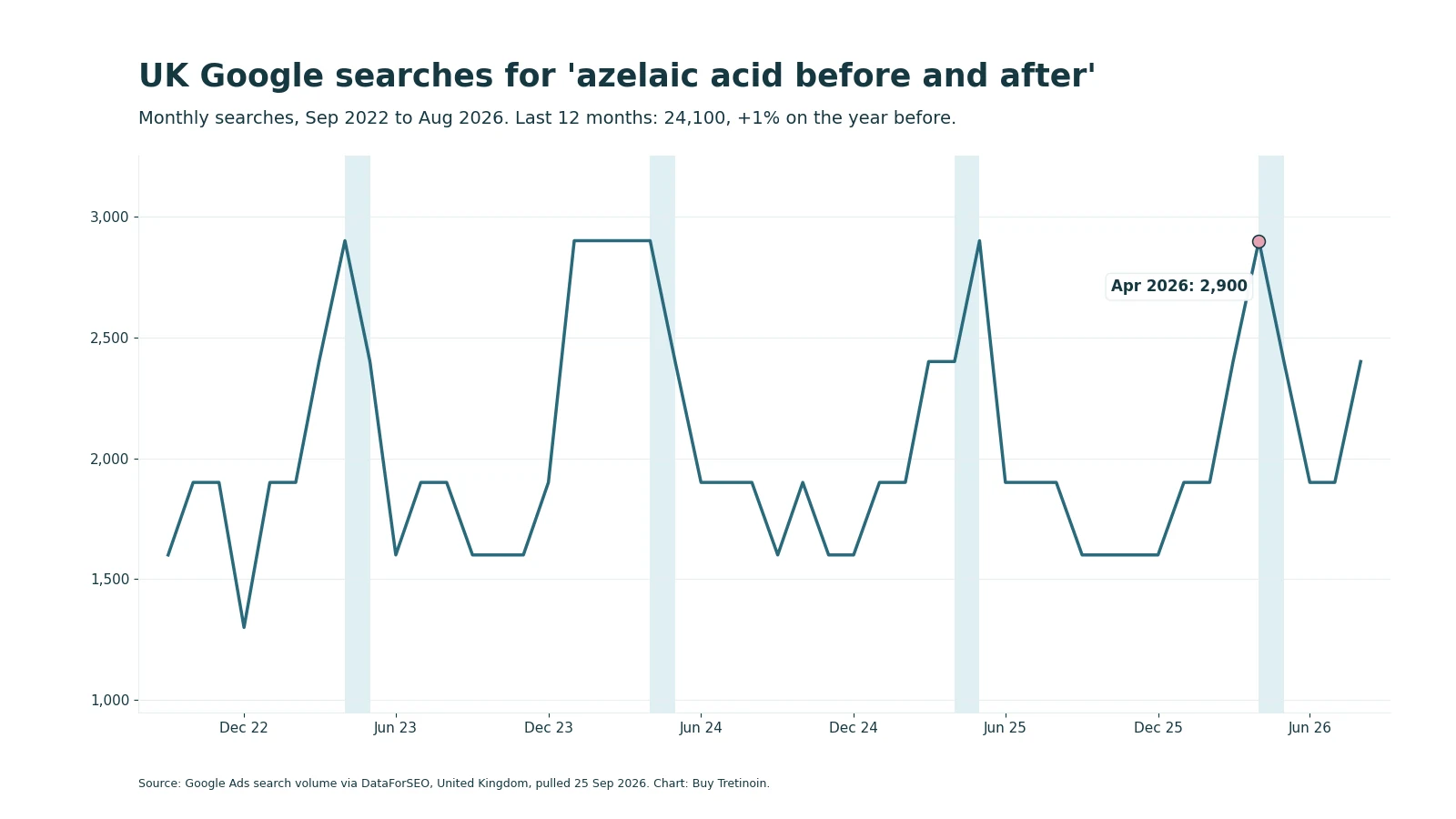
Our analysis of UK Google search data records 24,100 searches for “azelaic acid before and after” in the 12 months to August 2026, compared with 23,900 in the previous 12 months. Those rounded totals are almost unchanged. April reached 2,900 searches in 2026, the highest monthly bucket in that 12-month period. Earlier April values were also high, though 2025 peaked in May.
Search volume rises in spring in some years, though the figures do not explain what prompted those searches. Google groups close variants into rounded volume buckets, so they show broad changes in interest over time.
Azelaic acid purging: tingling, irritation and breakouts
Azelaic acid can cause burning, stinging, tingling or itching, particularly early in treatment. In studies of 15% gel for rosacea, these were among the common local reactions and were usually mild or transient. Persistent or worsening irritation needs advice from your prescriber.
A breakout after starting treatment does not show that azelaic acid is working. The studies measured acne lesions and irritation, and did not identify purging as a required stage of treatment. If you are also using a retinoid, irritation can have more than one cause. Our guide to the tretinoin purge explains the signs to track with that medicine.
How to get the best before and after
Use the formulation and schedule your prescriber recommended. The steps below can help you track changes and notice irritation.
- Apply the amount stated on your prescription or patient leaflet. Keep to its schedule rather than increasing use to speed up a result.
- Apply to clean, dry skin if your directions say to do so.
- Use sunscreen during the day, particularly when treating pigmentation. Sunscreen was used alongside treatment in the melasma comparison trials.
- Keep the rest of your routine simple while you assess tolerance. Add other active ingredients gradually.
- Take a photo every 4 weeks in the same room, lighting and position. Avoid filters and compare the same area of skin.
If you are using tretinoin as well, ask the prescriber how to fit both into your routine. Some people use azelaic acid and tretinoin at different times, but the combination can irritate skin and needs individual guidance. Tretinoin, adapalene and tazarotene should not be used during pregnancy or when trying to conceive. Ask a prescriber about treatment if you are pregnant or planning pregnancy.
Azelaic acid cream or gel: choosing a formulation
Trials tested 20% cream and 15% gel in different study populations. Your prescriber can help choose a formulation that suits your skin and diagnosis.
From our order data (Sep 2025 to Sep 2026): we recorded 325 azelaic acid-only units, including 295 cream units (91%) and 30 gel units (9%). This is one UK store’s data for 2025-09-14 to 2026-09-14; these are units, not people. December 2025 had no orders, which may reflect a store closure or a data gap.
For guidance on applying a prescribed product, read how to use azelaic acid safely. In the UK, azelaic acid at 15% to 20% is a prescription-only medicine, so use it under a prescriber’s care. Prescription-only medicines require a valid prescription. Lower-strength cosmetic products use different formulations, so results from trials of prescription medicines do not describe their effects.
When azelaic acid may not be enough
Azelaic acid may not address every cause of facial redness or pigmentation. Persistent acne, scarring, painful spots or a diagnosis such as melasma may need a review and a different plan. For rosacea that affects the eyes, contact a GP promptly.
Stop using azelaic acid and speak to a GP, pharmacist or dermatologist if you notice any of the following:
- severe burning, swelling, blistering or a rash
- eye pain, light sensitivity or a gritty feeling in your eyes
- worsening acne, painful nodules or new scarring
- pigmentation that is spreading, changing quickly or has an uncertain cause
- pregnancy, trying to conceive, or questions about a prescribed combination cream
Our guide to azelaic acid for rosacea covers that condition in more detail. The tretinoin and hydroquinone guide explains another prescription combination. Do not start, stop or combine prescription medicines based only on a blog post.
Discussing azelaic acid treatment
Azelaic acid at 15% to 20% is prescription-only in the UK. Our azelaic acid range is listed for reference. Ask your prescriber to confirm that the formulation and strength match your prescription.
Frequently asked questions
How should I compare azelaic acid before and after?
Look for gradual changes in the concern being treated, such as fewer inflamed spots, less visible redness or fading post-acne marks. Compare photos in the same light every four weeks. In a 15% gel trial, researchers measured changes in some acne-related marks at weeks 8 to 12. Ask your prescriber when to review treatment.
Does azelaic acid lighten skin?
Azelaic acid may reduce excess pigmentation, including post-acne marks and melasma, making uneven areas look closer to the surrounding skin tone. It does not change your natural complexion. Melasma studies used 20% cream, often with sunscreen; their findings describe study groups rather than an individual result.
Should I moisturise over azelaic acid?
If your prescriber or product directions allow it, you can apply moisturiser after azelaic acid has settled. A plain, fragrance-free moisturiser may help if your skin feels dry or tight. Introduce one new product at a time so you can identify what causes irritation. Follow the instructions for your prescribed formulation.
How long for azelaic acid to work, and should I use it morning or night?
Follow the directions from your prescriber or the product information. In acne treatment, NHS guidance describes cream or gel use twice daily, with once daily as an option for particularly sensitive skin. Rosacea trials also assessed once- and twice-daily use of 15% gel. Do not change a prescribed schedule without checking first.
What are the downsides of azelaic acid?
Burning, stinging, itching, dryness and redness can occur. In trials, some reactions were mild or transient, but persistent discomfort deserves advice. Stop using it and speak to a GP, pharmacist or dermatologist if you develop swelling, blistering, severe pain, eye symptoms or worsening irritation.
Can I use azelaic acid for hyperpigmentation?
Azelaic acid may help with some forms of excess pigmentation, including post-acne marks and melasma. The studies we reviewed tested 15% gel or 20% cream. They do not show how every cosmetic serum will perform. A clinician can help identify the cause of pigmentation and discuss suitable treatment. Use sunscreen as directed, especially when treating melasma.
Is 10% azelaic acid as good as 20%?
The studies we reviewed tested 15% gel and 20% cream. One acne trial compared 10% nanocrystal hydrogel with 20% cream, so its result applies to those formulations. In the UK, azelaic acid at 15% to 20% is prescription-only medicine.
How we wrote this
We reviewed the PubMed abstracts linked above, including trials and reviews of azelaic acid for acne, rosacea, melasma and post-acne marks. We also analysed monthly UK Google search data from September 2022 to August 2026 and our order data from September 2025 to September 2026. The studies report group outcomes. Search data records query volumes, and our order figures cover one UK store. Neither source describes every person using azelaic acid.
This post provides general information. For advice about your own treatment, speak to a GP, pharmacist or dermatologist. Last reviewed 25 September 2026. Corrections: support@buytretinoin.org.